Find the right combination
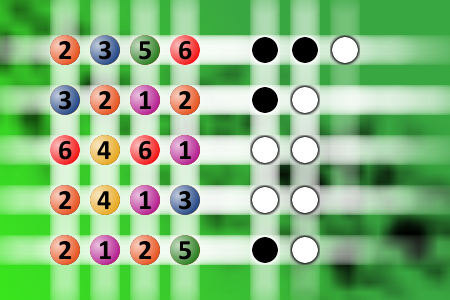
[8047] Find the right combination - The computer chose a secret code (sequence of 4 digits from 1 to 6). Your goal is to find that code. Black circles indicate the number of hits on the right spot. White circles indicate the number of hits on the wrong spot. - #brainteasers #mastermind - Correct Answers: 1
BRAIN TEASERS
enter your answer and press button OK

Find the right combination

The computer chose a secret code (sequence of 4 digits from 1 to 6). Your goal is to find that code. Black circles indicate the number of hits on the right spot. White circles indicate the number of hits on the wrong spot.
Correct answers: 1
#brainteasers #mastermind
Register with your Google Account and start collecting points.
Check your ranking on list.

Praying for a Parking Space

A laywoman was driving down the street in a sweat because she had an important meeting and couldn’t find a parking space. Looking up toward heaven, she said, “Lord, take pity on me. If you find me a parking place I’ll go to Mass every Sunday for the rest of my life and give up drinking wine.”
Miraculously, a parking space opened up right in front of her destination.
The woman looked up to heaven and said, “Never mind, Lord; I found one on my own.”
Jokes of the day - Daily updated jokes. New jokes every day.
Follow Brain Teasers on social networks

Brain Teasers

puzzles, riddles, mathematical problems, mastermind, cinemania...

Carl Wilhelm Scheele

Born 9 Dec 1742; died 21 May 1786 at age 43. (also Karl) Swedish chemist who discovered oxygen in 1772. Scheele, a keen experimenter, worked in difficult and often hazardous conditions. In his only book, Chemical Observations and Experiments on Air and Fire (1777), he stated that the atmosphere is composed of two gases, one supporting combustion, which he named "fire air" (oxygen), and the other preventing it, which he named "vitiated air" (nitrogen). Due to delay in his publication, he lost priority to Priestley's discovery of oxygen in 1774. Scheele discovered many substances, such as chlorine (1774), manganese (1774), tungsten (1781), molybdenum (1782), glycerol, hydrocyanic (prussic) acid, citric acid, hydrogen sulphide and hydrogen fluoride. He also discovered a process resembling pasteurization.
This site uses cookies to store information on your computer. Some are essential to help the site properly. Others give us insight into how the site is used and help us to optimize the user experience. See our privacy policy.