
Find a famous person
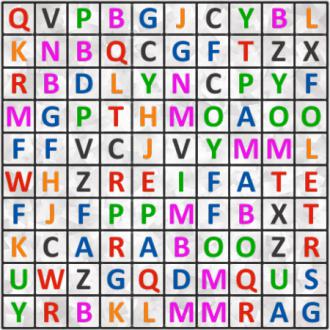
[6499] Find a famous person - Find the first and the last name of a famous person. Text may go in all 8 directions. Length of words in solution: 6,5. - #brainteasers #wordpuzzles - Correct Answers: 13 - The first user who solved this task is Nílton Corrêa de Sousa
BRAIN TEASERS
enter your answer and press button OK

Find a famous person

Find the first and the last name of a famous person. Text may go in all 8 directions. Length of words in solution: 6,5.
Correct answers: 13
The first user who solved this task is Nílton Corrêa de Sousa.
#brainteasers #wordpuzzles
Register with your Google Account and start collecting points.
Check your ranking on list.

Irish Marriage Jokes

Paddy was an inveterate drunkard. The priest met him one day, and gave him a strong lecture about drink.
He said, "If you continue drinking as you do, you'll gradually get smaller and smaller, and eventually you'll turn into a mouse."
This frightened the life out of Paddy. He went home that night, and said to his wife, "Bridget....if you should notice me getting smaller and smaller, will ye kill that blasted cat?"
Shamrock
A surgeon and an architect, both English, were joined by an Irish politician, and all fell to arguing as to whose profession was the oldest.
Said the surgeon, "Eve was made from Adam's rib, and that surely was a surgical operation."
"Maybe," said the architect, "but prior to that, order was created out of chaos, and that was an architectural job."
"Shure now," interrupted the politician, "but somebody created the chaos first."
Jokes of the day - Daily updated jokes. New jokes every day.
Follow Brain Teasers on social networks

Brain Teasers

puzzles, riddles, mathematical problems, mastermind, cinemania...

Tungsten filaments

In 1913, Dr William David Coolidge patented (U.S. No. 1,082,933) a method for making ductile tunsten for the purpose of making filaments for electric lamps. When Coolidge joined the General Electric Research Laboratory (1905), he was given the task of replacing the fragile carbon filaments in electric light bulbs with tungsten filaments, although tungsten was difficult to work. He developed a way to superheat the metal tunsten in order to draw it out into the fine threads used for lamp filaments. Coolidge then improved the X-ray tube by using a heated tungsten filament cathode in vacuum producing electrons, instead of residual gas molecules in the tube. This permitted higher operating voltages, higher energy X rays and the treatment of deeper-seated tumors.
This site uses cookies to store information on your computer. Some are essential to help the site properly. Others give us insight into how the site is used and help us to optimize the user experience. See our privacy policy.