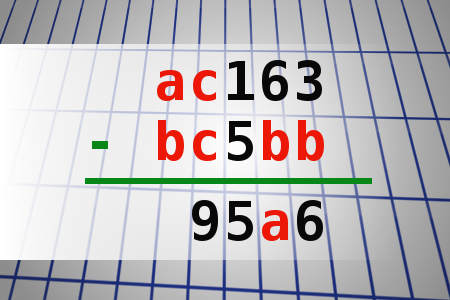
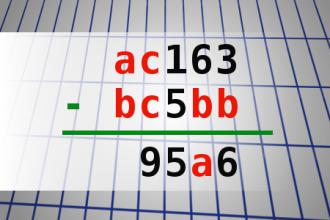
Find number abc
[7272] Find number abc - If ac163 - bc5bb = 95a6 find number abc. Multiple solutions may exist. - #brainteasers #math - Correct Answers: 10
BRAIN TEASERS
enter your answer and press button OK

Find number abc

If ac163 - bc5bb = 95a6 find number abc. Multiple solutions may exist.
Correct answers: 10
#brainteasers #math
Register with your Google Account and start collecting points.
Check your ranking on list.

One day The Lord came to Adam ...

One day The Lord came to Adam to pass on some news. "I've got some good news and some bad news," The Lord said.

Adam looked at The Lord and said, "Well, give me the good news first."

Smiling, The Lord explained, "I've got two new organs for you. One is called a brain. It will allow you to create new things, solve problems, and have intelligent conversations with Eve. The other organ I have for you is called a penis. It will give you great physical pleasure and allow you to reproduce your now intelligent life form and populate this planet. Eve will be very happy that you now have this organ to give her children."

Adam, very excited, exclaimed, "These are great gifts you have given to me. What could possibly be bad news after such great tidings?"

The Lord looked upon Adam and said with great sorrow, "You will never be able to use these two gifts at the same time."
Jokes of the day - Daily updated jokes. New jokes every day.
Follow Brain Teasers on social networks

Brain Teasers

puzzles, riddles, mathematical problems, mastermind, cinemania...

Brown's Australian voyage ends

In 1803, Robert Brown (1773-1858), botanist on Matthew Flinders' vessel HMS Investigator ended a long voyage of discovery in Port Jackson, Australia. From the ship's arrival at the continent's western coast (then known as New Holland or Terra Australis) in Dec 1801, age 27, he had made an enormous collection of plant samples which he classified and named. He published the results in his famous Prodromus Florae Novae Hollandiae in 1810, now a classic in systematic botany, although it was unillustrated, and failed to sell well at the time. He was the leading British botanist to collect in Australia in the early 19th century. He also described Brownian motion: random motion observed by microscope of pollen immersed in water (1827).
This site uses cookies to store information on your computer. Some are essential to help the site properly. Others give us insight into how the site is used and help us to optimize the user experience. See our privacy policy.