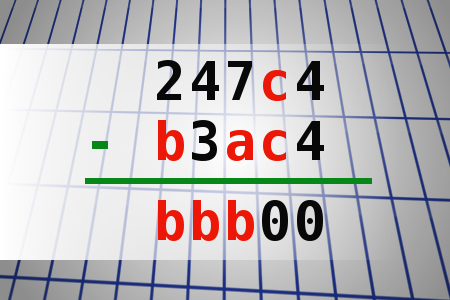
Find number abc
[2077] Find number abc - If 247c4 - b3ac4 = bbb00 find number abc. Multiple solutions may exist. - #brainteasers #math - Correct Answers: 105 - The first user who solved this task is Djordje Timotijevic
BRAIN TEASERS
enter your answer and press button OK

Find number abc

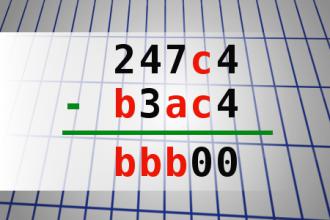
If 247c4 - b3ac4 = bbb00 find number abc. Multiple solutions may exist.
Correct answers: 105
The first user who solved this task is Djordje Timotijevic.
#brainteasers #math
Register with your Google Account and start collecting points.
Check your ranking on list.

In what aisle could I find the Polish...

"In what aisle could I find the Polish sausage?" a guy asks.
The clerk looks at him and says, "Are you Polish?"
The guy (clearly offended) says, "Well, yes I am. But let me ask you something. If I had asked for Italian sausage, would you ask me if I was Italian? Or if I had asked for German Bratwurst, would you ask me if I was German? Or if I asked for a kosher hot dog would you ask me if I was Jewish? Or if I had asked for a Taco, would you ask if I was Mexican? If I asked for some Irish whiskey, would you ask if I was Irish?"
The clerk says, "Well, no, I probably wouldn't!"
With deep self-righteous indignation, the guy says, "Well then, why did you ask me if I'm Polish because I asked for Polish sausage?"
The clerk replied, "Because you're in Home Depot."
Jokes of the day - Daily updated jokes. New jokes every day.
Follow Brain Teasers on social networks

Brain Teasers

puzzles, riddles, mathematical problems, mastermind, cinemania...

John B. Watson

Born 9 Jan 1878; died 25 Sep 1958 at age 80. John Broadus Watson was an American psychologist whose ideas initiated behaviorism as a branch of psychology. Inspired by the recent work of Ivan Pavlov, he studied the biology, physiology, and behavior of animals. Watson viewed animals as extremely complex machines that responded to situations according to their “wiring,”or nerve pathways that were conditioned by experience. When he continued with studies of the behavior of children, his conclusion was that humans, while more complicated than animals, operated on the same principles. Watson's behaviourism dominated psychology in the U.S. in the 1920s and '30s.
This site uses cookies to store information on your computer. Some are essential to help the site properly. Others give us insight into how the site is used and help us to optimize the user experience. See our privacy policy.