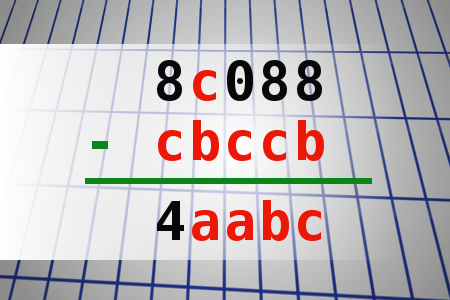
Find number abc
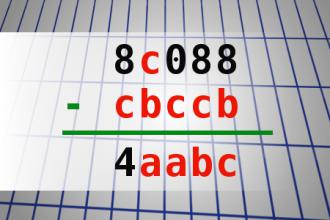
[2244] Find number abc - If 8c088 - cbccb = 4aabc find number abc. Multiple solutions may exist. - #brainteasers #math - Correct Answers: 49 - The first user who solved this task is Roxana zavari
BRAIN TEASERS
enter your answer and press button OK

Find number abc

If 8c088 - cbccb = 4aabc find number abc. Multiple solutions may exist.
Correct answers: 49
The first user who solved this task is Roxana zavari.
#brainteasers #math

Register with your Google Account and start collecting points.
Check your ranking on list.

What does that one do?

A man entered a pet shop, wanting to buy a parrot. The shop owner pointed out three identical parrots on a perch and said, "The parrot to the left costs 500 dollars."

"Why does that parrot cost so much?" the man wondered.

The owner replied, "Well, it knows how to use a computer."

The man asked about the next parrot on the perch.

"That one costs 1,000 dollars because it can do everything the other parrot can do, plus it knows how to use the UNIX operating system." Naturally, the startled customer asked about the third parrot.

"That one costs 2,000 dollars."

"And what does that one do?" the man asked.

The owner replied, "To be honest, I've never seen him do a thing, but the other two call him boss!"

Jokes of the day - Daily updated jokes. New jokes every day.
Follow Brain Teasers on social networks

Brain Teasers

puzzles, riddles, mathematical problems, mastermind, cinemania...

Wilhelm Wien

Born 13 Jan 1864; died 30 Aug 1928 at age 64. German physicist who received the Nobel Prize for Physics in 1911 for his displacement law concerning the radiation emitted by the perfectly efficient blackbody (a surface that absorbs all radiant energy falling on it). While studying streams of ionized gas Wien, in 1898, identified a positive particle equal in mass to the hydrogen atom. Wien, with this work, laid the foundation of mass spectroscopy. J. J. Thomson refined Wien's apparatus and conducted further experiments in 1913 then, after work by Ernest Rutherford in 1919, Wien's particle was accepted and named the proton. Wien also made important contributions to the study of cathode rays, X-rays and canal rays.
This site uses cookies to store information on your computer. Some are essential to help the site properly. Others give us insight into how the site is used and help us to optimize the user experience. See our privacy policy.