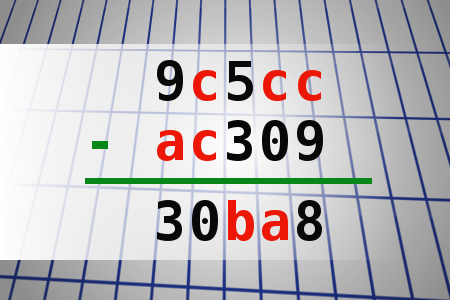
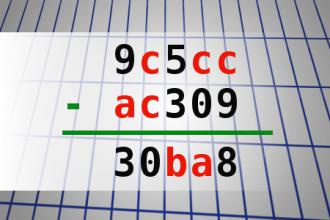
Find number abc
[3436] Find number abc - If 9c5cc - ac309 = 30ba8 find number abc. Multiple solutions may exist. - #brainteasers #math - Correct Answers: 71 - The first user who solved this task is Djordje Timotijevic
BRAIN TEASERS
enter your answer and press button OK

Find number abc

If 9c5cc - ac309 = 30ba8 find number abc. Multiple solutions may exist.
Correct answers: 71
The first user who solved this task is Djordje Timotijevic.
#brainteasers #math
Register with your Google Account and start collecting points.
Check your ranking on list.

A dietitian was once addressin...

A dietitian was once addressing a large audience in Chicago:

"The material we put into our stomachs is enough to have killed most of us sitting here, years ago. Red meat is awful. Soft drinks erode your stomach lining. Chinese food is loaded with MSG. Vegetables can be disastrous, and none of us realizes the long-term harm caused by the germs in our drinking water.

"But there is one thing that is the most dangerous of all and we all have eaten or will eat it. Can anyone here tell me what food it is that causes the most grief and suffering for years after eating it?"

A 75-year-old man in the front row stood up and said, "Wedding cake."
Jokes of the day - Daily updated jokes. New jokes every day.
Follow Brain Teasers on social networks

Brain Teasers

puzzles, riddles, mathematical problems, mastermind, cinemania...

Robert Innes

Died 13 Mar 1933 at age 71 (born 10 Nov 1861).Robert Thorburn Ayton Innes was a Scottish astronomer who discovered Proxima Centauri (1915), the closest star to earth after the Sun. Invited by David Gill to the Cape Observatory, South Africa (1894), he became a successful binary star observer with the 7-inch refractor (1628 discoveries). His most famous discovery, Proxima Centauri is a faint star near the binary star Alpha Centauri, which is so far south it is not visible from most of the northern hemisphere. He was also the first to see the Daylight Comet of 1910, though this comet was found independently by so many people in the Southern Hemisphere that no single "original'' discoverer could be named. Innes recorded it on 17 Jan 1910.
This site uses cookies to store information on your computer. Some are essential to help the site properly. Others give us insight into how the site is used and help us to optimize the user experience. See our privacy policy.