Find number abc
[5374] Find number abc - If 5659a - a8ab6 = c8b67 find number abc. Multiple solutions may exist. - #brainteasers #math - Correct Answers: 41 - The first user who solved this task is Djordje Timotijevic
BRAIN TEASERS
enter your answer and press button OK

Find number abc

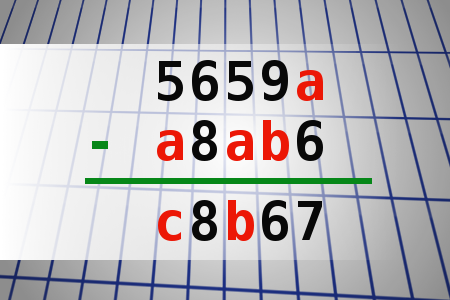
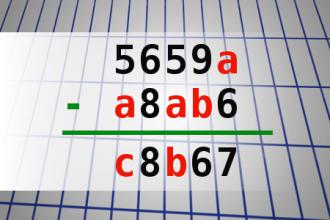
If 5659a - a8ab6 = c8b67 find number abc. Multiple solutions may exist.
Correct answers: 41
The first user who solved this task is Djordje Timotijevic.
#brainteasers #math
Register with your Google Account and start collecting points.
Check your ranking on list.

This an interactive joke, so h...

This an interactive joke, so have a piece of paper and pen handy.
A blonde woman walks into an auto parts store and the parts man asks how she is doing and what can he do for her. She replies, "Fine, I need a seven-ten cap for my car." The man asks," A seven-ten cap? Where does it go, I've never heard of such a thing?"
The blonde angrily replies, "It goes on top of the engine and don't think just because I'm blonde I don't know what I'm talking about!!" Perplexed,the parts man asks if she would draw him a picture and maybe help him out in figuring out what it is she needs.
Reader: Draw the number 710 in the middle of the paper and draw a circle around the whole number. Now turn the paper upside down.
Jokes of the day - Daily updated jokes. New jokes every day.
Follow Brain Teasers on social networks

Brain Teasers

puzzles, riddles, mathematical problems, mastermind, cinemania...

Charles Alfred Coulson

Born 13 Dec 1910; died 7 Jan 1974 at age 63. British theoretical chemist known for the application of molecular orbital theory to chemical bonding, the electronic structures of molecules and the concept of partial valency. He developed many mathematical techniques for solving chemical and physical problems. His molecular orbital theory treats a molecule as a whole, and extends atomic quantum theory with “allowed” states of electrons associated with two or more atomic nuclei. With this approach, he explained the structure of benzene and other conjugated systems, and using what he called partial valency, he described the bonding in such compounds as diborane. After writing on Waves (1941) and Electricity (1941), his book Valence (1952) was highly influential. He also wrote on reconciling scientific and religious views, believing religious faith was an essential in the pursuit of science.«
This site uses cookies to store information on your computer. Some are essential to help the site properly. Others give us insight into how the site is used and help us to optimize the user experience. See our privacy policy.