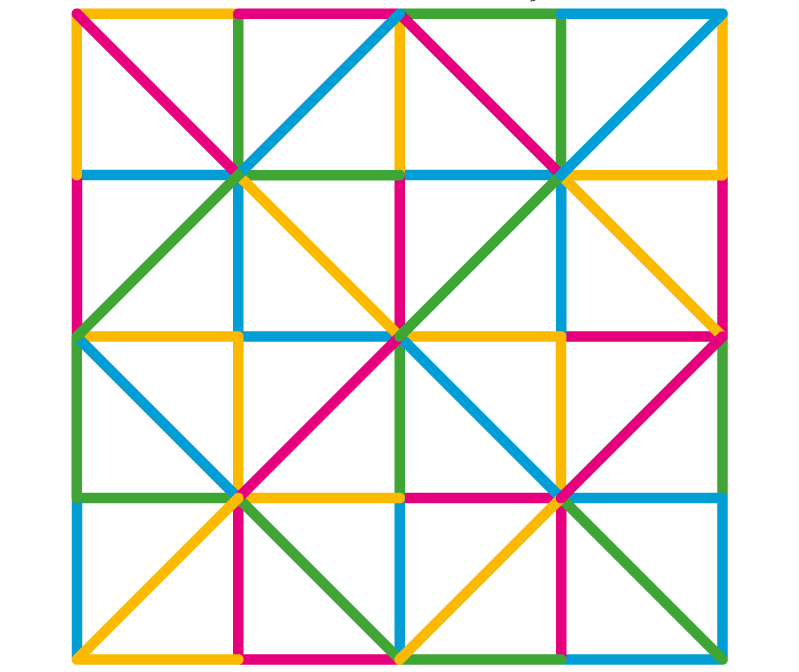
How many triangles?
[3752] How many triangles? - MATH PUZZLE: How many triangles? - #brainteasers #math #riddles - Correct Answers: 78 - The first user who solved this task is Djordje Timotijevic
BRAIN TEASERS
enter your answer and press button OK

How many triangles?

MATH PUZZLE: How many triangles?
Correct answers: 78
The first user who solved this task is Djordje Timotijevic.
#brainteasers #math #riddles
Register with your Google Account and start collecting points.
Check your ranking on list.

Sam consistently caught more f...

Sam consistently caught more fish than anyone else. Whereas the other guys would only catch three or four a day, Sam would come in off the lake with a boat full. Stringer after stringer was always packed with freshly trout. The warden, curious, asked Sam his secret. The successful fisherman invited the game warden to accompany him and observe.
So the next morning the two met at the dock and took off in Sam's boat. When they got to the middle of the lake, they stopped the boat and the warden sat back to see how it was done. Sam's approach was simple. He took out a stick of dynamite, lit it, and threw it in the air. The explosion rocked the lake with such a force that dead fish immediately began to surface. Sam took out a net and started scooping them up. Well, you can imagine the reaction of the game warden. When he recovered from the shock of it all, he began yelling at Sam. "You can't do this! I'll put you in jail, buddy! You will be paying every fine there is in the book!"
Sam, meanwhile, set his net down and took out another stick of dynamite. He lit it and threw it in the lap of the game warden with these words, "Are you going to sit there all day complaining or are you going to fish?"
Jokes of the day - Daily updated jokes. New jokes every day.
Follow Brain Teasers on social networks

Brain Teasers

puzzles, riddles, mathematical problems, mastermind, cinemania...

John H. Van Vleck

Born 13 Mar 1899; died 27 Oct 1980 at age 81.John Hasbrouck Van Vleck was an American physicist and mathematician who pioneered in the modern quantum mechanical theory of magnetism, and shared the 1977 Nobel Prize for Physics (with Philip W. Anderson and Sir Nevill F. Mott) for his work on the behaviour of electrons in magnetic, noncrystalline solid materials. In about 1930, he introduced the contribution of the second-order Zeeman effect into the theory of the paramagnetic susceptibility for the ions of the elements samarium and europium, thus bringing calculations into agreement with experimental results. Hans Bethe's theoretical work (c.1929), was extended by Van Vleck to develop the ligand, or crystal, field theory of molecular bonding. He also studied the theory for the nature of the chemical bond, especially as related to its magnetic properties, and contributed to theory of the spectra of free molecules.«
This site uses cookies to store information on your computer. Some are essential to help the site properly. Others give us insight into how the site is used and help us to optimize the user experience. See our privacy policy.