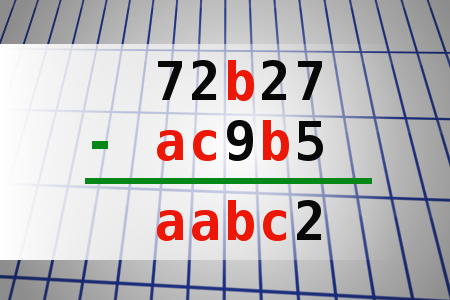
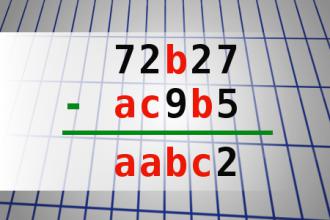
Find number abc
[5473] Find number abc - If 72b27 - ac9b5 = aabc2 find number abc. Multiple solutions may exist. - #brainteasers #math - Correct Answers: 35 - The first user who solved this task is Nílton Corrêa De Sousa
BRAIN TEASERS
enter your answer and press button OK

Find number abc

If 72b27 - ac9b5 = aabc2 find number abc. Multiple solutions may exist.
Correct answers: 35
The first user who solved this task is Nílton Corrêa De Sousa.
#brainteasers #math

Register with your Google Account and start collecting points.
Check your ranking on list.

Shalom Race

As you may know, in a shalom race the skier must pass through about 20 "gates" in the fastest time. Well, it happened that Israel had the fastest slalom skier in the world and had great expectations for an Olympic gold medal.
Came the day of the final, the crowd waited in anticipation. The French champion sped down the course in 38 seconds. The Swiss in 38.7 seconds, the German in 37.8 seconds and the Italian in 38.1 seconds. Next came the Israeli's turn ... the crowd waited, and waited...six minutes!
"What happened to you?" screamed his trainer when the Israeli finally arrived. Replied the exhausted Israeli: "Which of those idiots put a mezuzah on each gate?"
Jokes of the day - Daily updated jokes. New jokes every day.
Follow Brain Teasers on social networks

Brain Teasers

puzzles, riddles, mathematical problems, mastermind, cinemania...

Alexander Parkes

Died 29 Jun 1890 at age 76 (born 29 Dec 1813).British industrial chemist who invented many processes. Parkes was an expert in electroplating, able to silver-plate such diverse objects as a spider web and flowers. He patented a method of rubber coating fabrics to waterproof them (1841), an electroplating process (1843), and a method of extracting silver from lead ore by adding zinc (1850). He produced the first plastic (1855), which he called Parkesine, by dissolving cellulose nitrate in alcohol and camphor containing ether. The hard solid result could be molded when heated, but he could find no market for the material. (This was rediscovered in the 1860s by John Wesley Hyatt, an American chemist, who named it celluloid and successfully marketed it as a replacement for ivory.«
This site uses cookies to store information on your computer. Some are essential to help the site properly. Others give us insight into how the site is used and help us to optimize the user experience. See our privacy policy.