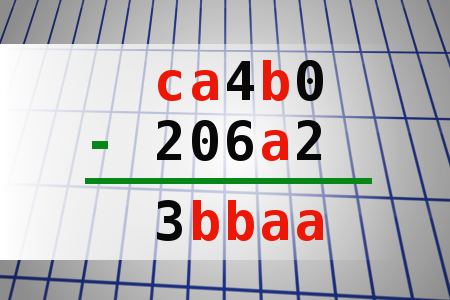
Find number abc
[5561] Find number abc - If ca4b0 - 206a2 = 3bbaa find number abc. Multiple solutions may exist. - #brainteasers #math - Correct Answers: 31 - The first user who solved this task is Djordje Timotijevic
BRAIN TEASERS
enter your answer and press button OK

Find number abc

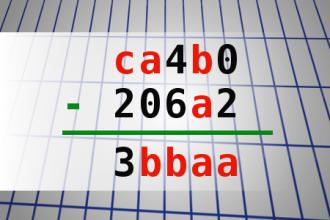
If ca4b0 - 206a2 = 3bbaa find number abc. Multiple solutions may exist.
Correct answers: 31
The first user who solved this task is Djordje Timotijevic.
#brainteasers #math
Register with your Google Account and start collecting points.
Check your ranking on list.

Last year, when the power mowe...

Last year, when the power mower was broken and wouldn't run, I kept hinting to my husband that he ought to get it fixed, but somehow the message never sank in. Finally I thought of a clever way to make the point.
When my husband arrived home that day, he found me seated in the tall grass, busily snipping away with a tiny pair of sewing scissors.
He watched silently for a short time and then went into the house. He was gone only a few moments when he came out again. He handed me a toothbrush. "When you finish cutting the grass," he said, "you might as well sweep the sidewalks."
Jokes of the day - Daily updated jokes. New jokes every day.
Follow Brain Teasers on social networks

Brain Teasers

puzzles, riddles, mathematical problems, mastermind, cinemania...

Addison Emery Verrill

Born 9 Feb 1839; died 10 Dec 1926 at age 87.American zoologist and naturalist who, ascuratorof zoology at the Peabody Museum of Natural History at Yale University, developed one of the largest, most valuable zoological collections in the U.S. He trained under Louis Agassiz at Harvard University. At age 25, Verrill, became Yale University's first professor of Zoology. His lifelong devotion to taxonomic research resulted in the initial development of extensive collections at Yale in a wide variety of taxa. From 1871-87, while he was in charge of scientific explorations by the U.S. Commission of Fish and Fisheries, Verrill found and described hundreds of new marine specimens. He specialized in invertebrates, especially worms, mollusks, corals, sponges, and starfishes, and made important technical improvements in the equipment used for collecting specimens. His expeditions took him to the Atlantic and Pacific coasts of North America and to Hawaii and Central America. He published more than 350 papers and monographs, including descriptions of more than a thousand species of animals in virtually every major taxon. His breadth of interests included parasitology, mineralogy and botany.
This site uses cookies to store information on your computer. Some are essential to help the site properly. Others give us insight into how the site is used and help us to optimize the user experience. See our privacy policy.