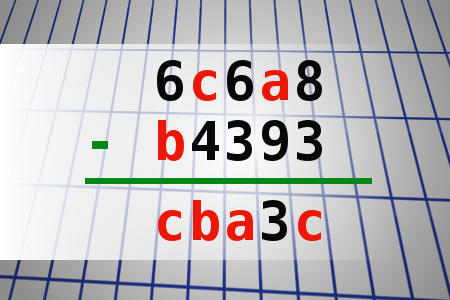
Find number abc
[5764] Find number abc - If 6c6a8 - b4393 = cba3c find number abc. Multiple solutions may exist. - #brainteasers #math - Correct Answers: 42 - The first user who solved this task is Nílton Corrêa De Sousa
BRAIN TEASERS
enter your answer and press button OK

Find number abc

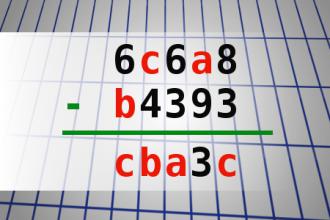
If 6c6a8 - b4393 = cba3c find number abc. Multiple solutions may exist.
Correct answers: 42
The first user who solved this task is Nílton Corrêa De Sousa.
#brainteasers #math
Register with your Google Account and start collecting points.
Check your ranking on list.

He who laughs last thinks slow...

He who laughs last thinks slowest.

Depression is merely anger without enthusiasm.

The early bird may get the worm, but the second mouse gets the cheese.

I drive way too fast to worry about cholesterol.

Support bacteria. They're the only culture some people have.

Monday is an awful way to spend 1/7 of your week.

A clear conscience is usually the sign of a bad memory.

Change is inevitable, except from vending machines.

Get a new car for your spouse. It'll be a great trade!

Plan to be spontaneous tomorrow.

Always try to be modest, and be proud of it!
Jokes of the day - Daily updated jokes. New jokes every day.
Follow Brain Teasers on social networks

Brain Teasers

puzzles, riddles, mathematical problems, mastermind, cinemania...

Charles B. Huggins

Died 12 Jan 1997 at age 95 (born 22 Sep 1901).Charles Brenton Huggins was a Canadian-born American surgeon and urologist whose investigations demonstrated the relationship between hormones and certain types of cancer. In 1939, Huggins made a very simple inference that led to the development of new forms of cancer therapy. Noting that the prostate gland was under the control of androgens (male sex hormones) he concluded that cancer of the prostate might be treated by preventing the production of androgens. In 1941, he began to inject with female sex hormones to neutralize the effect of androgens produced by the testicles. For his discoveries Huggins received (with Peyton Rous) the Nobel Prize for Physiology or Medicine in 1966.
This site uses cookies to store information on your computer. Some are essential to help the site properly. Others give us insight into how the site is used and help us to optimize the user experience. See our privacy policy.