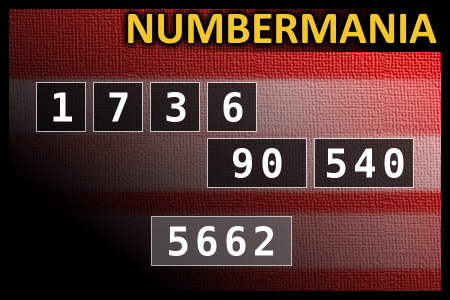
Calculate the number 5662
[1481] Calculate the number 5662 - NUMBERMANIA: Calculate the number 5662 using numbers [1, 7, 3, 6, 90, 540] and basic arithmetic operations (+, -, *, /). Each of the numbers can be used only once. - #brainteasers #math #numbermania - Correct Answers: 32 - The first user who solved this task is Sanja Šabović
BRAIN TEASERS
enter your answer and press button OK

Calculate the number 5662

NUMBERMANIA: Calculate the number 5662 using numbers [1, 7, 3, 6, 90, 540] and basic arithmetic operations (+, -, *, /). Each of the numbers can be used only once.
Correct answers: 32
The first user who solved this task is Sanja Šabović.
#brainteasers #math #numbermania
Register with your Google Account and start collecting points.
Check your ranking on list.

Adam's ribs

At Sunday School they were teaching how God created everything, including human beings.

Little Johnny, a child in the kindergarten class, seemed especially intent when they told him how Eve was created out of one of Adam's ribs.

Later in the week his mother noticed him lying as though he were ill, and said. "Johnny what is the matter?" Little Johnny responded, "I have a pain in my side. I think I'm going to have a wife."

Jokes of the day - Daily updated jokes. New jokes every day.
Follow Brain Teasers on social networks

Brain Teasers

puzzles, riddles, mathematical problems, mastermind, cinemania...

Julian Lowell Coolidge

Born 28 Sep 1873; died 5 Mar 1954 at age 80. American mathematician and educator noted for numerous published works in theoretical mathematics. He earned a B.A. degree at Harvard (1895), then a B.Sc. (1897) from Oxford, England, the first natural science degree ever awarded at Oxford. He began teaching at Groton School, Conn. (1897-99) where one of his pupils was Franklin D Roosevelt, the future U.S. president. Coolidge was an instructor at Harvard University, taking leave to study abroad (1902-04) with Corrado Segre at Turin and Eduard Studyat the University of Bonn ( Ph.D. 1904). When he returned to Harvard, he remained there for the rest of his career. Later in life, he took an interest in his subject's history, writing Mathematics of the Great Amateurs (1949).«
This site uses cookies to store information on your computer. Some are essential to help the site properly. Others give us insight into how the site is used and help us to optimize the user experience. See our privacy policy.