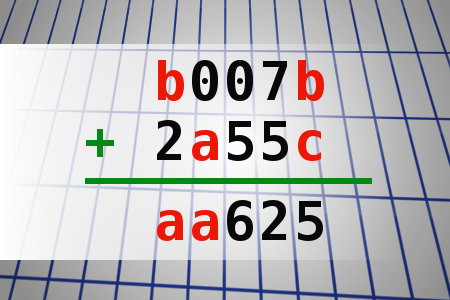
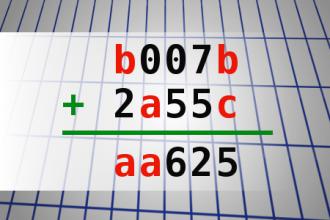
Find number abc
[5978] Find number abc - If b007b + 2a55c = aa625 find number abc. Multiple solutions may exist. - #brainteasers #math - Correct Answers: 36 - The first user who solved this task is Nasrin 24 T
BRAIN TEASERS
enter your answer and press button OK

Find number abc

If b007b + 2a55c = aa625 find number abc. Multiple solutions may exist.
Correct answers: 36
The first user who solved this task is Nasrin 24 T.
#brainteasers #math
Register with your Google Account and start collecting points.
Check your ranking on list.

Mud bath

An elderly man goes into his doctor’s office for an annual physical. After a while, the doctor comes out and says: "I'm sorry, Bill, but we have discovered you have a condition that only allows you another six weeks to live."

"But Doctor," Bill replies, "I feel great. I haven't felt better in years. This just can't be true. Isn't there anything I can do?"

After a moment, the doctor says: "Well, you might start going down the street to that new health spa to take a mud bath every day."

"And that will cure me?" Bill asks excitedly.

"No," replies the doctor: "but it will get you used to the dirt."

Jokes of the day - Daily updated jokes. New jokes every day.
Follow Brain Teasers on social networks

Brain Teasers

puzzles, riddles, mathematical problems, mastermind, cinemania...

Rembrandt Peale

Died 3 Oct 1860 at age 82 (born 22 Feb 1778). American artist and naturalist, son of Charles Willson Peale, who followed his father as a portrait painter with an interest in natural history. Many of Rembrandt Peale's portraits are of scientists. He also took an interest in the technology of his era, including the pioneering steam navigation of John Fitch and Robert Fulton, gas lighting of Baltimore's streets, and the chemistry of pigments. In 1801, he assisted his father's excavation of mastodon bones from the peat bogs of Orange County, New York, from which they assembled two skeletons. One was mounted in his father's Philadelphia Museum. Rembrandt displayed another as a travelling exhibit around New York (1802) and London (1802, 1803). From the details of its fossil teeth, he believed the mastodon was a carnivor, though Georges Cuvier shortly established it was a herbivor.«
This site uses cookies to store information on your computer. Some are essential to help the site properly. Others give us insight into how the site is used and help us to optimize the user experience. See our privacy policy.