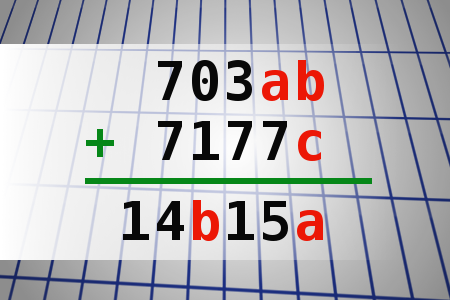
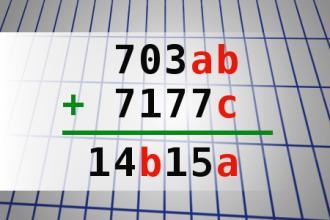
Find number abc
[5985] Find number abc - If 703ab + 7177c = 14b15a find number abc. Multiple solutions may exist. - #brainteasers #math - Correct Answers: 30 - The first user who solved this task is Nasrin 24 T
BRAIN TEASERS
enter your answer and press button OK

Find number abc

If 703ab + 7177c = 14b15a find number abc. Multiple solutions may exist.
Correct answers: 30
The first user who solved this task is Nasrin 24 T.
#brainteasers #math
Register with your Google Account and start collecting points.
Check your ranking on list.

We've all heard about people...

We've all heard about people having guts or balls. But do you really know the difference between them? In an effort to keep you informed, the definition of each is listed below:
"Guts" is arriving home late after a night out with the guys, being assaulted by your wife with a broom, and having the guts to say, "Are you still cleaning or are you flying somewhere?"
"Balls," is coming home late after a night out with the guys, smelling of perfume and beer, lipstick on your collar, slapping your wife square on the arse and having the balls to say, "You're next, fatty!"
Jokes of the day - Daily updated jokes. New jokes every day.
Follow Brain Teasers on social networks

Brain Teasers

puzzles, riddles, mathematical problems, mastermind, cinemania...

Philip Hauge Abelson

Born 27 Apr 1913; died 1 Aug 2004 at age 91. American physical chemist who proposed the gas diffusion process for separating uranium-235 from uranium-238 which was essential to the development of the atomic bomb. In collaboration with the U.S. physicist Edwin M. McMillan, he discovered a new element, later named neptunium, produced by irradiating uranium with neutrons. At the end WW II, his report on the feasibility of building a nuclear-powered submarine gave birth to the U.S. program in that field. In 1946, Abelson returned to the Carnegie Institution and pioneered in utilizing radioactive isotopes. As director of the Geophysics Laboratory of the Carnegie Institution (1953-71), he found amino acids in fossils, and fatty acids in rocks more than 1,000,000,000 years old.
This site uses cookies to store information on your computer. Some are essential to help the site properly. Others give us insight into how the site is used and help us to optimize the user experience. See our privacy policy.