MAGIC SQUARE: Calculate A*B+C
[5986] MAGIC SQUARE: Calculate A*B+C - The aim is to place the some numbers from the list (4, 7, 8, 9, 10, 13, 15, 16, 67, 69, 70, 81) into the empty squares and squares marked with A, B an C. Sum of each row and column should be equal. All the numbers of the magic square must be different. Find values for A, B, and C. Solution is A*B+C. - #brainteasers #math #magicsquare - Correct Answers: 17 - The first user who solved this task is Nasrin 24 T
BRAIN TEASERS
enter your answer and press button OK

MAGIC SQUARE: Calculate A*B+C

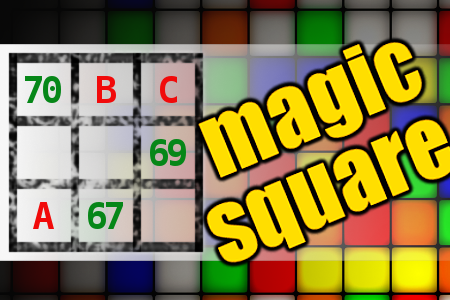
The aim is to place the some numbers from the list (4, 7, 8, 9, 10, 13, 15, 16, 67, 69, 70, 81) into the empty squares and squares marked with A, B an C. Sum of each row and column should be equal. All the numbers of the magic square must be different. Find values for A, B, and C. Solution is A*B+C.
Correct answers: 17
The first user who solved this task is Nasrin 24 T.
#brainteasers #math #magicsquare
Register with your Google Account and start collecting points.
Check your ranking on list.

I finally got one over

The other day, Louise and I got into some petty argument. (I say it was petty. She would have said it was Armageddon.) As is our nature, neither of us would admit the possibility that we might be in error.
To her credit, Louise finally said, 'Look. I'll tell you what. I'll admit I'm wrong if you admit I was right.'
'Fine.' I said.
She took a deep breath, looked me in the eye and said, 'I'm wrong.'
I grinned and replied, 'You're right.'

Jokes of the day - Daily updated jokes. New jokes every day.
Follow Brain Teasers on social networks

Brain Teasers

puzzles, riddles, mathematical problems, mastermind, cinemania...

Alfred Bernhard Nobel

Died 10 Dec 1896 at age 63 (born 21 Oct 1833). Swedish chemist and inventor who invented dynamite and other, more powerful explosives. An explosives expert like his father, in 1866 he invented a safe and manageable form of nitroglycerin he called dynamite, and later, smokeless gunpowder and (1875) gelignite. He helped to create an industrial empire manufacturing many of his other inventions. Nobel amassed a huge fortune, much of which he left in a fund to endow the annual prizes that bear his name. First awarded in 1901, these prizes were for achievements in the areas of physics, chemistry, physiology or medicine, literature, and peace. The sixth prize, for economics, was instituted in his honour in 1969.
This site uses cookies to store information on your computer. Some are essential to help the site properly. Others give us insight into how the site is used and help us to optimize the user experience. See our privacy policy.