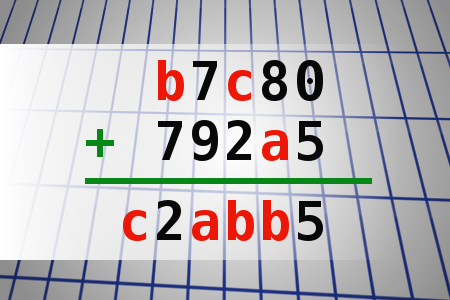
Find number abc
[6113] Find number abc - If b7c80 + 792a5 = c2abb5 find number abc. Multiple solutions may exist. - #brainteasers #math - Correct Answers: 23 - The first user who solved this task is Nasrin 24 T
BRAIN TEASERS
enter your answer and press button OK

Find number abc

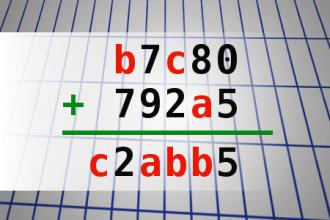
If b7c80 + 792a5 = c2abb5 find number abc. Multiple solutions may exist.
Correct answers: 23
The first user who solved this task is Nasrin 24 T.
#brainteasers #math
Register with your Google Account and start collecting points.
Check your ranking on list.

A wife was making a breakfast ...

A wife was making a breakfast of fried eggs for her husband.
Suddenly, her husband burst into the ki tchen.
"Careful," he said, "CAREFUL! Put in some more butter! Oh my GOD!
You're cooking too many at once. TOO MANY! Turn them! TURN THEM NOW! We need more butter. Oh my GOD! WHERE are we going to get MORE BUTTER? They're going to STICK! Careful . CAREFUL! I said be CAREFUL! You NEVER listen to me when you're cooking! Never! Turn them! Hurry up! Are you CRAZY? Have you LOST your mind? Don't forget to salt them. You know you always forget to salt them.
Use the salt. USE THE SALT! THE SALT!"

The wife stared at him. "What in the world is wrong with you? You think I don't know how to fry a couple of eggs?"

The husband calmly replied, "I just wanted to show you what it feels like when I'm driving."
Jokes of the day - Daily updated jokes. New jokes every day.
Follow Brain Teasers on social networks

Brain Teasers

puzzles, riddles, mathematical problems, mastermind, cinemania...

Sir J.J. Thomson

Born 18 Dec 1856; died 30 Aug 1940 at age 83. Joseph John Thomson was an English physicist who helped revolutionize the knowledge of atomic structure by his discovery of the electron (1897). He received the Nobel Prize for Physics in 1906 and was knighted in 1908. Thomson experimented with currents of electricity inside empty glass tubes, investigating a long-standing puzzle known as “cathode rays.” His experiments prompted him to make a bold proposal: these mysterious rays are streams of particles much smaller than atoms. He called these particles “corpuscles,” and suggested that they might make up all of the matter in atoms. It was startling to imagine particles inside the atom at a time when most people thought that the atom was indivisible, the most fundamental unit of matter.
This site uses cookies to store information on your computer. Some are essential to help the site properly. Others give us insight into how the site is used and help us to optimize the user experience. See our privacy policy.