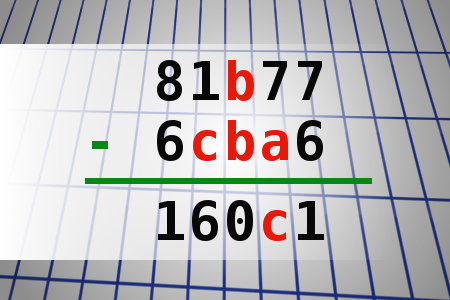
Find number abc
[6179] Find number abc - If 81b77 - 6cba6 = 160c1 find number abc. Multiple solutions may exist. - #brainteasers #math - Correct Answers: 38 - The first user who solved this task is Nasrin 24 T
BRAIN TEASERS
enter your answer and press button OK

Find number abc

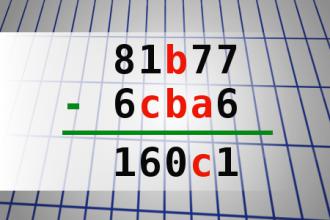
If 81b77 - 6cba6 = 160c1 find number abc. Multiple solutions may exist.
Correct answers: 38
The first user who solved this task is Nasrin 24 T.
#brainteasers #math
Register with your Google Account and start collecting points.
Check your ranking on list.

Bless This Car

A rabbi, a priest and a minister have their houses of worship side by side, so they decide to carpool.
On the first day, the other two are shocked to see the pastor lay hands on the hood and pray silently.
"What are you doing?" the priest asks.
The pastor looks up. "I'm just dedicating the car to the Lord's service."
"Good idea! Be right back!" the priest exclaims, running into his church. He emerges with a bulb on a short stick, shaking water out of it onto the car.
The rabbi stares. "What are you doing?" he says.
"I'm consecrating it with holy water," the priest replies.
"Great idea!" the rabbi says, and runs into his synagogue's toolshed. He emerges with a hacksaw and takes off an inch of the tailpipe.

Jokes of the day - Daily updated jokes. New jokes every day.
Follow Brain Teasers on social networks

Brain Teasers

puzzles, riddles, mathematical problems, mastermind, cinemania...

Irving Langmuir

Died 16 Aug 1957 at age 76 (born 31 Jan 1881). American physical chemist whose studies of molecular films on solid and liquid surfaces opened new fields in colloid research and biochemistry and won him the Nobel Prize for Chemistry in 1932. His early work on gases led to the invention of the Langmuir condensation pump. In 1913, Langmuir found that the life of the tungsten vacuum bulbs then in use could be extended considerably if they were filled with a mixture of nitrogen and argon. He also developed an atomic-hydrogen welding torch capable of temperatures up to 3,000°C, and made first use of the term plasma. While studying atomic structure he introduced the terms covalence and electrovalence. In surface chemistry, he worked the phenomenon of adsorption and the application of this to catalysis.
This site uses cookies to store information on your computer. Some are essential to help the site properly. Others give us insight into how the site is used and help us to optimize the user experience. See our privacy policy.