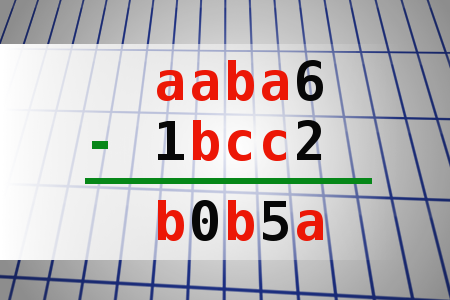
Find number abc
[6183] Find number abc - If aaba6 - 1bcc2 = b0b5a find number abc. Multiple solutions may exist. - #brainteasers #math - Correct Answers: 18 - The first user who solved this task is Nasrin 24 T
BRAIN TEASERS
enter your answer and press button OK

Find number abc

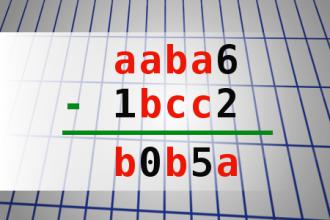
If aaba6 - 1bcc2 = b0b5a find number abc. Multiple solutions may exist.
Correct answers: 18
The first user who solved this task is Nasrin 24 T.
#brainteasers #math
Register with your Google Account and start collecting points.
Check your ranking on list.

A police officer in a small to...

A police officer in a small town stopped a motorist who was speeding down Main Street.
"But, officer," the man began, "I can explain..."
"Just be quiet," snapped the officer. "I'm going to let you cool your heels in jail until the chief gets back."
"But, officer, I just wanted to say..."
"And I said to keep quiet! You're going to jail!"
A few hours later the officer looked in on his prisoner and said, "Lucky for you that the chief's at his daughter's wedding. He'll be in a good mood when he gets back."
"Don't count on it," answered the fellow in the cell. "I'm the groom."
Jokes of the day - Daily updated jokes. New jokes every day.
Follow Brain Teasers on social networks

Brain Teasers

puzzles, riddles, mathematical problems, mastermind, cinemania...

Sir William Herschel

Died 25 Aug 1822 at age 83 (born 15 Nov 1738). German-born British astronomer, the founder of sidereal astronomy for the systematic observation of the heavens. In 1773, Herschel made and began using his first telescope. With it he began a project that would continue for the rest of his life: that of systematically studying the sky. Through this study he discovered the planet Uranus, many new nebulae, clusters of stars and binary stars. Herschel hypothesized that nebulae are composed of stars, developed a theory of stellar evolution and was the first person to correctly describe the form of our Galaxy, the Milky Way. He discovered the Saturnian satellites Mimas and Enceladus (1789) and the Uranian satellites Titania and Oberon (1787). He was probably the most famous astronomer of the 18th century.
This site uses cookies to store information on your computer. Some are essential to help the site properly. Others give us insight into how the site is used and help us to optimize the user experience. See our privacy policy.