Find number abc
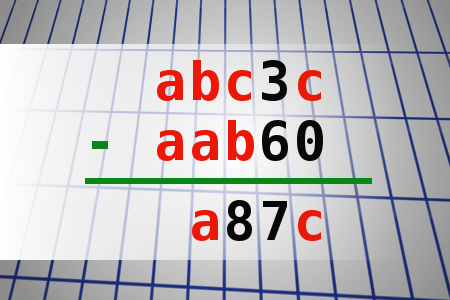
[6210] Find number abc - If abc3c - aab60 = a87c find number abc. Multiple solutions may exist. - #brainteasers #math - Correct Answers: 28 - The first user who solved this task is Nasrin 24 T
BRAIN TEASERS
enter your answer and press button OK

Find number abc

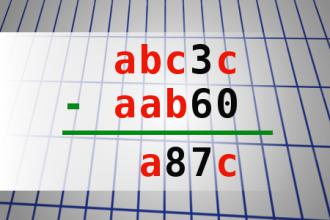
If abc3c - aab60 = a87c find number abc. Multiple solutions may exist.
Correct answers: 28
The first user who solved this task is Nasrin 24 T.
#brainteasers #math
Register with your Google Account and start collecting points.
Check your ranking on list.

A few fresh jokes to start Monday with a smile on your face

I walked into a bakery and asked the lady at the register if I could buy a bagel with cream cheese. "Sorry" she replied. "We only accept cash"

A fly with a bug on its back said
Hey is that a mite? The mite replied "I mite be".
The fly replied that's the worst joke I've ever heard!
The mite said, well I came up with it on the fly!

I took my dog to the park today to play frisbee with him…
He was useless!
I need a flatter dog!

I phoned my wife earlier and asked her if she wanted me to pick up Fish and Chips on my way home from work but she just grunted at me...
I think she still regrets letting me name the twins!

Jokes of the day - Daily updated jokes. New jokes every day.
Follow Brain Teasers on social networks

Brain Teasers

puzzles, riddles, mathematical problems, mastermind, cinemania...

Sir William Bayliss

Born 2 May 1860; died 27 Aug 1924 at age 64. William Maddock Bayliss was an English physiologist who, in 1902 co-discovered the first hormone (with the British physiologist Ernest H. Starling). They found a certain chemical substance is secreted when food comes into contact with part of the small intestine. This chemical substance, which they named secretin, upon being carried by the blood to the pancreas, stimulates the secretion of pancreatic juice, the most important of the digestive juices. They coined the word “hormone”based on a Greek word for “to set in motion.”Bayliss also studied the use of saline injections to counteract shock during surgery. He proposed the use of gum-saline injections for wound shock to saved many lives of wounded soldiers in WW I.«
This site uses cookies to store information on your computer. Some are essential to help the site properly. Others give us insight into how the site is used and help us to optimize the user experience. See our privacy policy.