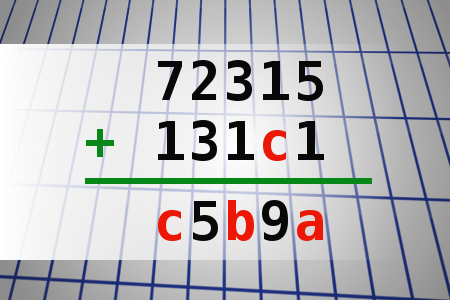
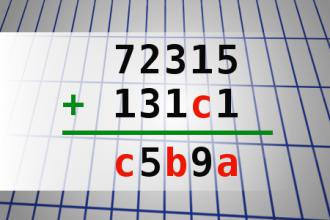
Find number abc
[6217] Find number abc - If 72315 + 131c1 = c5b9a find number abc. Multiple solutions may exist. - #brainteasers #math - Correct Answers: 29 - The first user who solved this task is Nasrin 24 T
BRAIN TEASERS
enter your answer and press button OK

Find number abc

If 72315 + 131c1 = c5b9a find number abc. Multiple solutions may exist.
Correct answers: 29
The first user who solved this task is Nasrin 24 T.
#brainteasers #math
Register with your Google Account and start collecting points.
Check your ranking on list.

A boy asks his dad...

A boy asks his dad, “What’s the difference between potential and realistic?” The dad tells him to go ask the rest of his family if they’d sleep with Brad Pitt for a million dollars, and then he’d tell him the answer. The boy goes up to his mom and asks her. She responds, “A million dollars is a lot of money sweetheart. I could send you, your sister, and your brother to great colleges, so sure, I would!” He then goes and asks his sister to which she replies, “Brad Pitt? Hell ya, he’s the hottest guy ever!” Next, the boy asks his brother who replies, “A million dollars? Hell yes I would. I’d be rich!” When the boy excitedly returns to his dad with the family’s responses, the dad says, “Well son, potentially, we have three million dollars. Realistically, we have two sluts and a queer.”
Jokes of the day - Daily updated jokes. New jokes every day.
Follow Brain Teasers on social networks

Brain Teasers

puzzles, riddles, mathematical problems, mastermind, cinemania...

Gerald S. Hawkins

Born 20 Apr 1928; died 26 May 2003 at age 75.Gerald Stanley Hawkins was an English-American radio astronomer and mathematician who used a computer to show that Stonehenge was a prehistoric astronomical observatory. In the 18th century, William Stukely had noticed that the horseshoe of trilithons and 19 bluestones opened up in the direction of the midsummer sunrise. Hawkins identified 165 key points that correlated the stones and other archaeological features of the neolithic complex to the rising and setting positions of the sun and moon over an 18.6-year cycle. He first published his findings in an article, Stonehenge Decoded, in the journal Nature (1963), and then in a book with the same title (1965). In Beyond Stonehenge he explored the mysteries of Machu Pichu, the Nasca Lines, Easter Island and the Egyptian Temples of Karnak and Amon-Ra. In the 1990s, he studied the geometry of crop circles.
This site uses cookies to store information on your computer. Some are essential to help the site properly. Others give us insight into how the site is used and help us to optimize the user experience. See our privacy policy.