Find number abc
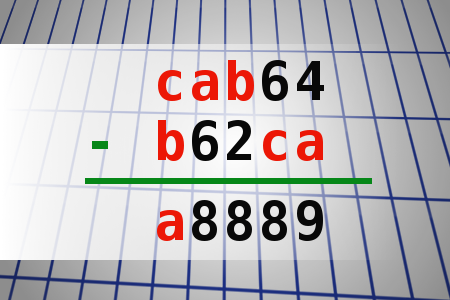
[6259] Find number abc - If cab64 - b62ca = a8889 find number abc. Multiple solutions may exist. - #brainteasers #math - Correct Answers: 15 - The first user who solved this task is Nasrin 24 T
BRAIN TEASERS
enter your answer and press button OK

Find number abc

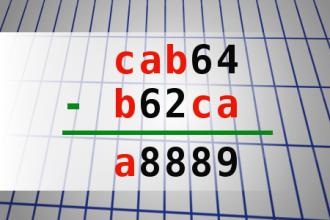
If cab64 - b62ca = a8889 find number abc. Multiple solutions may exist.
Correct answers: 15
The first user who solved this task is Nasrin 24 T.
#brainteasers #math
Register with your Google Account and start collecting points.
Check your ranking on list.

An elderly couple had dinner a...

An elderly couple had dinner at another couple's house, and after eating,the wives left the table and went into the kitchen.
The two gentlemen were talking, and one said, "Last night we went out to anew restaurant and it was really great. I would recommend it very highly."
The other man said, "What is the name of the restaurant?"
The first man thought and thought and finally said, "What is the name ofthat flower you give to someone you love? You know... the one that's red andhas thorns."
"Do you mean a rose?"
"Yes, that's the one," replied the man. He then turned towards the kitchenand yelled, "Rose, what's the name of that restaurant we went to lastnight?"
Jokes of the day - Daily updated jokes. New jokes every day.
Follow Brain Teasers on social networks

Brain Teasers

puzzles, riddles, mathematical problems, mastermind, cinemania...

Augustin Pyrame de Candolle

Died 9 Sep 1841 at age 63 (born 4 Feb 1778).Swiss botanist whose prolific writings in taxonomy and botany were highly influential, particularly his belief that taxonomy should be based on morphological characters, and his scheme of classification, for which he coined the term taxonomy, prevailed for many years. Candolle achieved extensive subdivision of flowering plants, describing 161 families of dicotyledons, and demonstrated decisively the inadequacy of Linnaean classification, which his system supplanted. Candolle also contributed to agronomy and the linking of soil type with vegetation. He also pioneered the study of phytogeography, the biogeography of plants, by carrying out investigations in Brazil (1827), East India (1829), and North China (1834).
This site uses cookies to store information on your computer. Some are essential to help the site properly. Others give us insight into how the site is used and help us to optimize the user experience. See our privacy policy.