Find the right combination
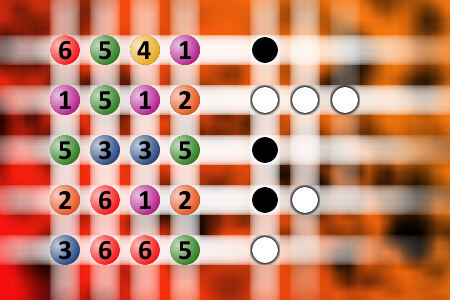
[6258] Find the right combination - The computer chose a secret code (sequence of 4 digits from 1 to 6). Your goal is to find that code. Black circles indicate the number of hits on the right spot. White circles indicate the number of hits on the wrong spot. - #brainteasers #mastermind - Correct Answers: 28 - The first user who solved this task is Nílton Corrêa de Sousa
BRAIN TEASERS
enter your answer and press button OK

Find the right combination

The computer chose a secret code (sequence of 4 digits from 1 to 6). Your goal is to find that code. Black circles indicate the number of hits on the right spot. White circles indicate the number of hits on the wrong spot.
Correct answers: 28
The first user who solved this task is Nílton Corrêa de Sousa.
#brainteasers #mastermind
Register with your Google Account and start collecting points.
Check your ranking on list.

Unlucky Parachutist

A man is skydiving, enjoying his free-fall, when he realizes that he has reached the altitude where he must open his parachute. So he pulls on the rip cord, but nothing happens.

“No problem,” he says to himself, “I still have my emergency chute.” So he pulls the rip cord on his emergency parachute, and once again, nothing happens.

Now the man begins to panic. “What am I going to do?” he thinks, “I'm a goner!”

Just then he sees a man flying up from the earth toward him. He can't figure out where this man is coming from, or what he's doing, but he thinks to himself, “Maybe he can help me. If he can't, then I'm done for.”

When the man gets close enough to him, the skydiver cups his hands and shouts down, “Hey, do you know anything about parachutes?”

The other man replies, “No! Do you know anything about gas stoves?”

Jokes of the day - Daily updated jokes. New jokes every day.
Follow Brain Teasers on social networks

Brain Teasers

puzzles, riddles, mathematical problems, mastermind, cinemania...

George B. Kistiakowsky

Born 18 Nov 1900; died 7 Dec 1982 at age 82.George Bogdan Kistiakowsky was a Russian chemist who worked on developing the first atomic bomb but later advocated banning nuclear weapons. He immigrated to the U.S. in 1926, and taught chemistry at Princeton University then Harvard (1930-71). He served as special assistant to President Eisenhower for science and technology (1959-61). As head of the explosives division of the Los Alamos Laboratory during WW II (1944-46), he oversaw 600 people developing explosives for the first atom bomb. The conventional explosives are used for its detonation to uniformly compress the plutonium sphere and achieve critical mass. In 1977, he became chairman of the Council for a Livable World, which opposes nuclear war.
This site uses cookies to store information on your computer. Some are essential to help the site properly. Others give us insight into how the site is used and help us to optimize the user experience. See our privacy policy.