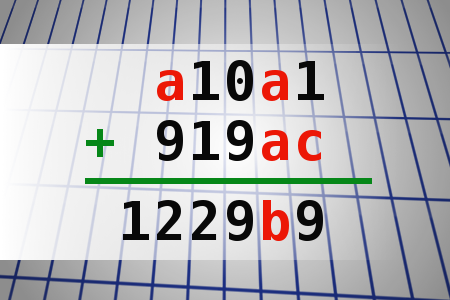
Find number abc
[6664] Find number abc - If a10a1 + 919ac = 1229b9 find number abc. Multiple solutions may exist. - #brainteasers #math - Correct Answers: 21 - The first user who solved this task is Nasrin 24 T
BRAIN TEASERS
enter your answer and press button OK

Find number abc

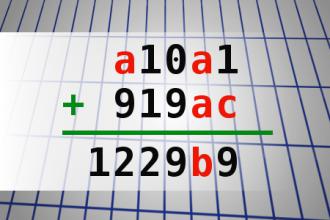
If a10a1 + 919ac = 1229b9 find number abc. Multiple solutions may exist.
Correct answers: 21
The first user who solved this task is Nasrin 24 T.
#brainteasers #math
Register with your Google Account and start collecting points.
Check your ranking on list.

Helping your father

A clergyman walking down a country lane and sees a young farmer struggling to load hay back onto a cart after it had fallen off.
"You look hot, my son," said the cleric. "why don't you rest a moment, and I'll give you a hand."
"No thanks," said the young man.
"My father wouldn't like it."
"Don't be silly," the minister said.
"Everyone is entitled to a break. Come and have a drink of water."
Again the young man protested that his father would be upset. Losing his patience, the clergyman said, "Your father must be a real slave driver. Tell me where I can find him and I'll give him a piece of my mind!"
"Well," replied the young farmer, "he's under the load of hay."

Jokes of the day - Daily updated jokes. New jokes every day.
Follow Brain Teasers on social networks

Brain Teasers

puzzles, riddles, mathematical problems, mastermind, cinemania...

Cyril Stanley Smith

Born 4 Oct 1903; died 25 Aug 1952 at age 48.British-American metallurgist who in 1943-44 determined the properties and technology of plutonium and uranium, the essential materials in the atomic bombs that were first exploded in 1945. Smith already then had 15 years of experience as a research metallurgist with the American Brass Co., during which time he studied properties of alloys and their microstructure. In WW II, he joined the Los Alamos Laboratory at its inception (1943). The properties and technology of plutonium had to be conducted with extremely limited quantities of available material. Smith and his group found it was unique, with five different allotropic forms with huge density differences between them. Postwar, he organized the Institute for the Study of Metal at the Univ. of Chicago.
This site uses cookies to store information on your computer. Some are essential to help the site properly. Others give us insight into how the site is used and help us to optimize the user experience. See our privacy policy.