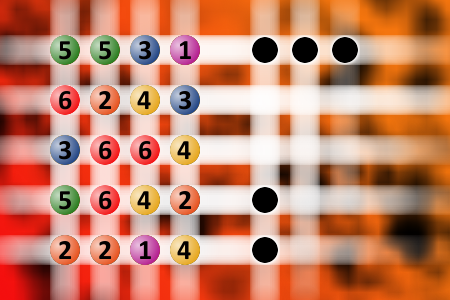
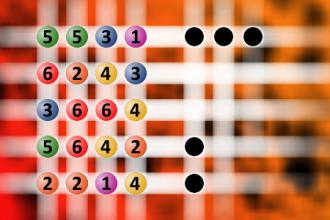
Which is a winning combination of digits?
[6663] Which is a winning combination of digits? - The computer chose a secret code (sequence of 4 digits from 1 to 6). Your goal is to find that code. Black circles indicate the number of hits on the right spot. White circles indicate the number of hits on the wrong spot. - #brainteasers #mastermind - Correct Answers: 34 - The first user who solved this task is Nasrin 24 T
BRAIN TEASERS
enter your answer and press button OK

Which is a winning combination of digits?

The computer chose a secret code (sequence of 4 digits from 1 to 6). Your goal is to find that code. Black circles indicate the number of hits on the right spot. White circles indicate the number of hits on the wrong spot.
Correct answers: 34
The first user who solved this task is Nasrin 24 T.
#brainteasers #mastermind
Register with your Google Account and start collecting points.
Check your ranking on list.

Gilbert Gottfried: Spoke to the Animals

A traveling salesman goes to a farm house. The farmer goes, I could put you up for one night, but youll have to stay in the barn. So he spends the night there and the next morning the farmer comes in, he goes, Were you comfortable? He goes, I had a great time; I talked to all the animals. He goes, You talked to the animals? He goes, Yeah I spoke to the chickens, they say you collect the eggs every morning exactly at five minutes after six. He goes, Thats exactly right. He says, The horse tells me his name is Otis, youve owned him for 10 years. He goes, Thats incredible. And he goes, I spoke to the cow, the cow says that her name is Elsie and you milk her every morning at exactly 8:30. And then I spoke to the sheep. And the farmer goes, Those sheep are lying.
Jokes of the day - Daily updated jokes. New jokes every day.
Follow Brain Teasers on social networks

Brain Teasers

puzzles, riddles, mathematical problems, mastermind, cinemania...

Wallace Clement Sabine

Died 10 Jan 1919 at age 50 (born 13 Jun 1868).Wallace Clement Ware Sabine was an American physicist who founded the science of architectural acoustics. After experimenting in the Fogg lecture room at Harvard, to investigate the effect of absorption on the reverberation time, on 29 Oct 1898 he discovered the type of relation between these quantities. The duration T of the residual sound to decay below the audible intensity, starting from a 1,000,000 times higher initial intensity is given by: T = 0.161 V/A (V=room volume in m³, A=total absorption in m². The first auditorium Sabine designed applying his new insight in acoustics, was the new Boston Music Hall, formally opened on 15 Oct 1900. Now known as the Symphony Hall, and still considered one of the world's three finest concert halls.
This site uses cookies to store information on your computer. Some are essential to help the site properly. Others give us insight into how the site is used and help us to optimize the user experience. See our privacy policy.