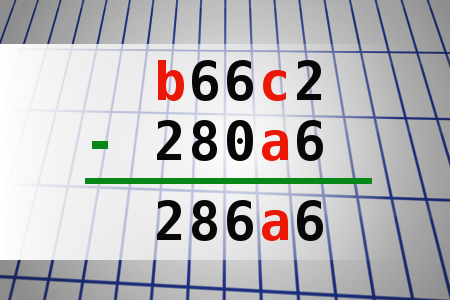
Find number abc
[6752] Find number abc - If b66c2 - 280a6 = 286a6 find number abc. Multiple solutions may exist. - #brainteasers #math - Correct Answers: 31 - The first user who solved this task is Nasrin 24 T
BRAIN TEASERS
enter your answer and press button OK

Find number abc

If b66c2 - 280a6 = 286a6 find number abc. Multiple solutions may exist.

Correct answers: 31
The first user who solved this task is Nasrin 24 T.
#brainteasers #math
Register with your Google Account and start collecting points.
Check your ranking on list.

A couple attending an art exhi...

A couple attending an art exhibition at the National Gallery was staring at a portrait that had them completely confused.
The painting depicted three very black and totally naked men sitting on a park bench. Two of the figures had black weenies, but the one in the middle had a pink weenie.
The curator of the gallery realized that they were having trouble interpreting the painting and offered his assessment.
He went on for nearly half an hour explaining how it depicted the sexual emasculation of African-Americans in a predominately white, patriarchal society. "In fact," he pointed out, "some serious critics believe that the pink weenie also reflects the cultural and sociological oppression experienced by gay men in contemporary society."
After the curator left, a young man in a Kentucky T-shirt approached the couple and said, "Would you like to know what the painting is really about?"
"Now why would you claim to be more of an expert than the curator of the gallery?" asked the couple.
"Because I'm the guy who painted it," he replied. "In fact, there are no African-Americans depicted at all. They're just three Kentucky coal miners, and the guy in the middle went home for lunch."
Jokes of the day - Daily updated jokes. New jokes every day.
Follow Brain Teasers on social networks

Brain Teasers

puzzles, riddles, mathematical problems, mastermind, cinemania...

Philip W. Anderson

Born 13 Dec 1923. Philip Warren Anderson is an American physicist who shared (with John H. Van Vleck and Sir Nevill F. Mott)the 1977 Nobel Prize for Physics for his research on semiconductors, superconductivity, and magnetism. He made contributions to the study of solid-state physics, and research on molecular interactions has been facilitated by his work on the spectroscopy of gases. He conceived a model (known as the Anderson model) to describe what happens when an impurity atom is present in a metal. He also investigated magnetism and superconductivity, and his work is of fundamental importance for modern solid-state electronics, making possible the development of inexpensive electronic switching and memory devices in computers.
This site uses cookies to store information on your computer. Some are essential to help the site properly. Others give us insight into how the site is used and help us to optimize the user experience. See our privacy policy.