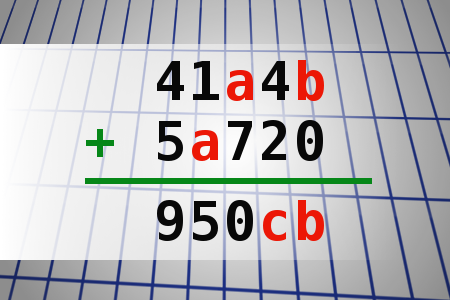
Find number abc
[6860] Find number abc - If 41a4b + 5a720 = 950cb find number abc. Multiple solutions may exist. - #brainteasers #math - Correct Answers: 36 - The first user who solved this task is Nasrin 24 T
BRAIN TEASERS
enter your answer and press button OK

Find number abc

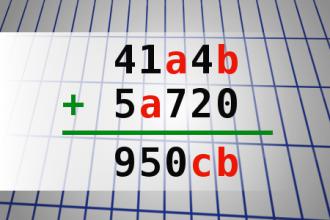
If 41a4b + 5a720 = 950cb find number abc. Multiple solutions may exist.
Correct answers: 36
The first user who solved this task is Nasrin 24 T.
#brainteasers #math
Register with your Google Account and start collecting points.
Check your ranking on list.

One evening, a man gave his ti...

One evening, a man gave his tipsy secretary a ride home after an office party. His wife was prone to jealousy, so he didn't mention the incident to her.
Later in the evening, he was driving his wife to a restaurant when he noticed a stiletto-heeled shoe half-hidden under the passenger seat. Gripped with terror, he took advantage of a moment when she wasn't looking to grab the shoe and throw it out of the window.
The rest of the journey went well until they arrived at the restaurant.
"That's strange," said his wife, looking a little agitated. "Have you seen my other shoe?"
Jokes of the day - Daily updated jokes. New jokes every day.
Follow Brain Teasers on social networks

Brain Teasers

puzzles, riddles, mathematical problems, mastermind, cinemania...

Achromatic lenses

In 1758, optician John Dolland, having created achromatic lenses, reported this to the Royal Society. Isaac Newton had described the blurring effect due to chromatic abberation, but could not solve the problem in simple lenses, which was important in the preparation of lenses for telescopes and microscopes. A concave face of a lens of flint glass (which has a greater color dispersion than crown glass) is cemented to a convex face of a crown glass lens. Thus the dispersion properties causing chromatic aberration are removed from both lenses simultaneously. Although Dollond patented the discovery of the achromatic lens in the mid-18th century, it is widely believed that he was not its inventor, but learned about it from lens maker George Bass.
This site uses cookies to store information on your computer. Some are essential to help the site properly. Others give us insight into how the site is used and help us to optimize the user experience. See our privacy policy.