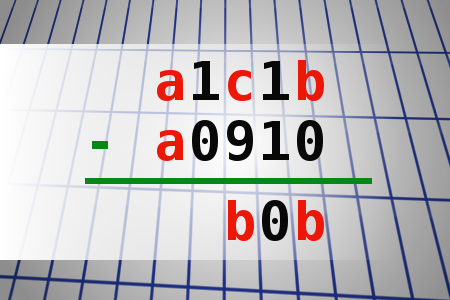
Find number abc
[6874] Find number abc - If a1c1b - a0910 = b0b find number abc. Multiple solutions may exist. - #brainteasers #math - Correct Answers: 19 - The first user who solved this task is Nasrin 24 T
BRAIN TEASERS
enter your answer and press button OK

Find number abc

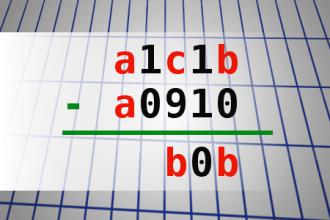
If a1c1b - a0910 = b0b find number abc. Multiple solutions may exist.
Correct answers: 19
The first user who solved this task is Nasrin 24 T.
#brainteasers #math
Register with your Google Account and start collecting points.
Check your ranking on list.

One lovely morning, Ben and Th...

One lovely morning, Ben and Thomas were out golfing. Ben slices his ball deep into a wooded ravine. He grabs his 8-iron and proceeds down the embankment into the ravine in search of his ball. Ben searches diligently through the thick underbrush and suddenly he spots something shiny. As he gets closer, he realizes that the shiny object is in fact an 8-iron in the hands of a skeleton lying near an old golf ball.
Ben excitedly calls out to his golfing partner: "Hey Thomas, come here, I got big trouble down here."
Thomas comes running over to the edge of the ravine and calls out, "What's the matter Ben?"
Ben shouts back in a nervous voice, "Throw me my 7-iron! Looks like you can't get out of here with an 8-iron."
Jokes of the day - Daily updated jokes. New jokes every day.
Follow Brain Teasers on social networks

Brain Teasers

puzzles, riddles, mathematical problems, mastermind, cinemania...

Carl Dietrich Harries

Born 5 Aug 1866; died 3 Nov 1923 at age 57. German chemist and industrialist who was one of the leading scientists in the elastomer field at the turn of the 20th century. He developed the ozonolysis process (Harries reaction) to determine the structure of natural rubber (polyisoprene). Breaking down the natural rubber substance by the action of ozone, Harries determined its molecular structure is made up from long chains containing many hundreds of isoprene molecules bonded together. That insight was followed up by Fritz Hofmann, who accomplished polymerization of pure isoprene to form synthetic rubber (Aug 1909). On 12 Sep 1909, his process was the granted the world's first patent (German No. 250690) on a “Method for producing synthetic rubber.”
This site uses cookies to store information on your computer. Some are essential to help the site properly. Others give us insight into how the site is used and help us to optimize the user experience. See our privacy policy.