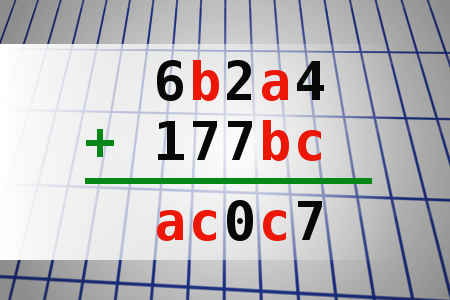
Find number abc
[6909] Find number abc - If 6b2a4 + 177bc = ac0c7 find number abc. Multiple solutions may exist. - #brainteasers #math - Correct Answers: 20 - The first user who solved this task is Nasrin 24 T
BRAIN TEASERS
enter your answer and press button OK

Find number abc

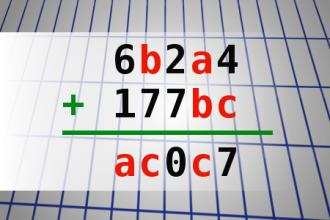
If 6b2a4 + 177bc = ac0c7 find number abc. Multiple solutions may exist.
Correct answers: 20
The first user who solved this task is Nasrin 24 T.
#brainteasers #math
Register with your Google Account and start collecting points.
Check your ranking on list.

TOP TEN SIGNS YOU HIRED THE WRONG KID TO MOW YOUR LAWN

10.He shows up with a pair of nail clippers and a Ziploc bag

9. On the side of his mower you notice the stenciled silhouettes of thirteen cats

8. Stops frequently to nap inside the grass-catcher

7. Always trying to impress you by stopping the mower blades with his head

6. You notice him shoving the last of his clothes into the mulcher

5. He's fascinated by the details of you home security system

4. Stops every couple of minutes to smoke some clippings

3. Somehow manages to mow the hood ornament off your Lexus

2. Turns a goat loose and says he'll be back in three weeks

1. No toes

Jokes of the day - Daily updated jokes. New jokes every day.
Follow Brain Teasers on social networks

Brain Teasers

puzzles, riddles, mathematical problems, mastermind, cinemania...

Norman Heatley

Died 5 Jan 2004 at age 92 (born 10 Jan 1911).English biochemist who solved problems in the extraction of penicillin from its mould, and paved the way for mass production. By D-Day of WW II, the Allies had an adequate stock to treat the wounded in danger of serious bacterial infections. Although it was Fleming who accidentally discovered penicillin (1928), it was Heatley who made it practical, making sufficient quantity by 1941 for its first clinical tests. His apparatus included porcelain "bedpans", milk churns and roasting trays to grow the bacteria. Also, an assay method he developed could precisely measure the activity of a sample of penicillin, in what became known as “Oxford units”. His production method used pie plates, cookie tins, and a porcelain vessel dubbed the bedpan.
This site uses cookies to store information on your computer. Some are essential to help the site properly. Others give us insight into how the site is used and help us to optimize the user experience. See our privacy policy.