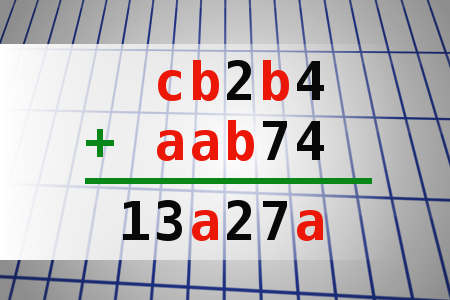
Find number abc
[7307] Find number abc - If cb2b4 + aab74 = 13a27a find number abc. Multiple solutions may exist. - #brainteasers #math - Correct Answers: 9
BRAIN TEASERS
enter your answer and press button OK

Find number abc

If cb2b4 + aab74 = 13a27a find number abc. Multiple solutions may exist.
Correct answers: 9
#brainteasers #math
Register with your Google Account and start collecting points.
Check your ranking on list.

Scary Collection 07

A witch joke
Why did the stupid witch keep her clothes in the fridge?
She liked to have something cool to slip into in the evenings!

A cannibal joke
What happened when the cannibals ate a comedian?
They had a feast of fun!

A ghost joke
What do you call a ghost's mother and father?
Transparents!

A vampire joke
Who plays centre forward for the vampire football team?
The ghoulscorer!

A witch joke
Why did the witch give up fortune telling?
There was no future in it!

A Halloween joke
Why was everyone tickled by the fried chicken at the Halloween party?
Because the feathers were still on the chicken!

A witch joke
What did the doctor say to the witch in hospital?
With any luck you'll soon be well enough to get up for a spell!

Jokes of the day - Daily updated jokes. New jokes every day.
Follow Brain Teasers on social networks

Brain Teasers

puzzles, riddles, mathematical problems, mastermind, cinemania...

Howard T. Ricketts

Died 3 May 1910 at age 39 (born 9 Feb 1871).Howard Taylor Ricketts was an American pathologist who discovered the causative organisms and mode of transmission of Rocky Mountain spotted fever and epidemic typhus. In 1906, Ricketts, a Univeristy of Chicago pathologist, demonstrated that Rocky Mountain spotted fever is spread by cattle ticks and caused by a blood-borne "bipolar bacillus." In 1910 he showed that typhus is caused by a similar organism carried by lice. Ricketts was in Mexico City investigating the disease (known in Mexico, as tabardillo) that year when he was stricken by typhus and died at age 39. The two organisms Ricketts discovered were the first of what were later shown to be an unusual genus of virus-like bacteria - now named the Rickettsiae.
This site uses cookies to store information on your computer. Some are essential to help the site properly. Others give us insight into how the site is used and help us to optimize the user experience. See our privacy policy.