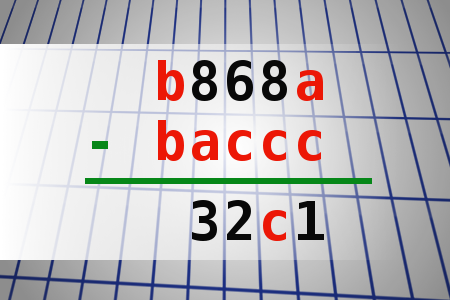
Find number abc
[6920] Find number abc - If b868a - baccc = 32c1 find number abc. Multiple solutions may exist. - #brainteasers #math - Correct Answers: 39 - The first user who solved this task is Nasrin 24 T
BRAIN TEASERS
enter your answer and press button OK

Find number abc

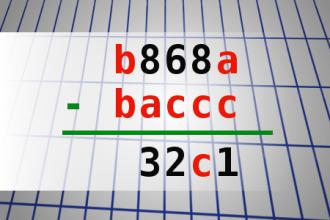
If b868a - baccc = 32c1 find number abc. Multiple solutions may exist.
Correct answers: 39
The first user who solved this task is Nasrin 24 T.
#brainteasers #math
Register with your Google Account and start collecting points.
Check your ranking on list.

She doesn’t trust easily

She doesn’t trust easily- you can see that in the distance creates between herself and around her, but she has much love to offer, and you can see it in the kindness that’s in the smiles she gives out to everyone around her. She has millions of chaotic galaxies of thoughts, thousands of tangled up worlds of words and places in her mind, and you can see it in the way her eyes always seem lost, like they are somewhere else. She always wants to be somewhere else, it shows in the way she’s always rushing and moving, the way she’s always restless. Life never went easy on her, and she didn’t go easy on herself either. She is strong and you can see it in her eyes, you can sense it in her voice. She believes that her body can physically rebuild and heal itself. I think that’s because she knew how to recover by herself after life had broken her. She knows how it’s like to be under-appreciated. So if you can’t see the beauty in her quirks, if you don’t think that maybe she might be a little piece of magic, don’t you dare and say that she is just a girl; because she’s a . ~ Author Unknown
Jokes of the day - Daily updated jokes. New jokes every day.
Follow Brain Teasers on social networks

Brain Teasers

puzzles, riddles, mathematical problems, mastermind, cinemania...

Cecilia Payne

Died 7 Dec 1979 at age 79 (born 10 May 1900).Cecilia Helena Payne-Gaposchkin was an English-American astronomer who was the first to apply laws of atomic physics to the study of the temperature and density of stellar bodies, and the first to conclude that hydrogen and helium are the two most common elements in the universe. During the 1920s, the accepted explanation of the Sun's composition was a calculation of around 65% iron and 35% hydrogen. At Harvard University, in her doctoral thesis (1925), Payne claimed that the sun's spectrum was consistent with another solution: 99% hydrogen with helium, and just 1% iron. She had difficulty persuading her superiors to take her work seriously. It was another 20 years before Payne's original claim was confirmed, by Fred Hoyle.
This site uses cookies to store information on your computer. Some are essential to help the site properly. Others give us insight into how the site is used and help us to optimize the user experience. See our privacy policy.