What a winning combination?
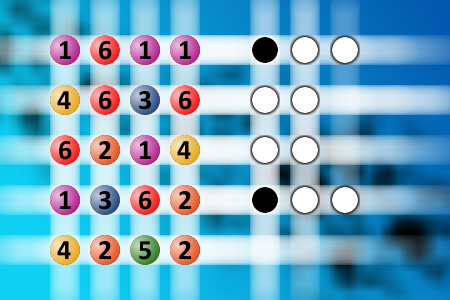
[6919] What a winning combination? - The computer chose a secret code (sequence of 4 digits from 1 to 6). Your goal is to find that code. Black circles indicate the number of hits on the right spot. White circles indicate the number of hits on the wrong spot. - #brainteasers #mastermind - Correct Answers: 20 - The first user who solved this task is Nasrin 24 T
BRAIN TEASERS
enter your answer and press button OK

What a winning combination?

The computer chose a secret code (sequence of 4 digits from 1 to 6). Your goal is to find that code. Black circles indicate the number of hits on the right spot. White circles indicate the number of hits on the wrong spot.
Correct answers: 20
The first user who solved this task is Nasrin 24 T.
#brainteasers #mastermind

Register with your Google Account and start collecting points.
Check your ranking on list.

A young boy walks into a barbe...

A young boy walks into a barber shop, and the barber leans in and says to his customer, "This is the dumbest kid in the world. Watch and see."

The barber then places a dollar bill in one hand and two quarters in the other, calling the boy over and asking, "Which one do you want, kid?"

The boy takes the quarters and leaves.

"See what I mean?" the barber says. "He never learns!"

Later, as the customer is leaving, he notices the same boy coming out of an ice cream parlor. "Hey, kid! Can I ask you something? Why did you pick the quarters over the dollar bill?"

The boy, enjoying his ice cream, replies, "Because if I took the dollar, the game would be over!"

Jokes of the day - Daily updated jokes. New jokes every day.
Follow Brain Teasers on social networks

Brain Teasers

puzzles, riddles, mathematical problems, mastermind, cinemania...

Mesons

In 1948, the University of California at Berkeley and the Atomic Energy Commission officially announced the artificial production of mesons using the 184-inch cyclotron at the university's Radiation Laboratory. Mesons in nature had previously been seen as cloud chamber tracks by Carl Anderson, and others (formed by cosmic rays) had been detected by other scientists in photographic plates made at high altitude. Now, at the limits of energy available from the cyclotron, these short-lived particles were generated artificially by Eugene Gardner and C.M.G. Lattes, using a beam of accelerated alpha particles fired at a thin carbon target. Time reported the discovery and hinted that the study of mesons might “lead in the direction of a vastly better source of atomic energy than the fission of uranium.”«[Image: Part of a photomicrograph of the track of one of the first mesons found by Gardener and Lattes, 1948. The meson enters from the bottom of this image. The star track shows a nuclear disintegration resulting from a colliding meson.]
This site uses cookies to store information on your computer. Some are essential to help the site properly. Others give us insight into how the site is used and help us to optimize the user experience. See our privacy policy.