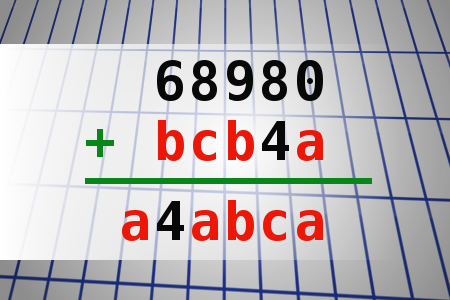
Find number abc
[6930] Find number abc - If 68980 + bcb4a = a4abca find number abc. Multiple solutions may exist. - #brainteasers #math - Correct Answers: 17 - The first user who solved this task is Nasrin 24 T
BRAIN TEASERS
enter your answer and press button OK

Find number abc

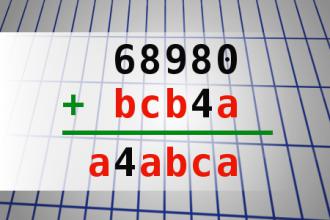
If 68980 + bcb4a = a4abca find number abc. Multiple solutions may exist.
Correct answers: 17
The first user who solved this task is Nasrin 24 T.
#brainteasers #math
Register with your Google Account and start collecting points.
Check your ranking on list.

A man joins a big corporate em...

A man joins a big corporate empire as a trainee. On his very first day of work, he dials the pantry and shouts into the phone, "Get me a coffee, quickly!"
The voice from the other side responded, "You fool you've dialed the wrong extension! Do you know who you're talking to, dumbo?"
"No," replied the trainee.
"It's the CEO of the company, you fool!"
The trainee shouts back, "And do you know who YOU are talking to, you fool?!"
"No," replied the CEO indignantly.
"Good!" replied the trainee, and puts down the phone.
Jokes of the day - Daily updated jokes. New jokes every day.
Follow Brain Teasers on social networks

Brain Teasers

puzzles, riddles, mathematical problems, mastermind, cinemania...

Frederic Eugene Ives

Died 27 May 1937 at age 81 (born 17 Feb 1856).American photographer and inventor of the halftone process, a method of reproducing photographs on a printing press. Prior to this process, photos and illustrations were reproduced from hand-engraved plates. In this way printers could reproduce line drawings, but not the shades of gray in a photograph because printing presses cannot print gray - only black and white. Ives invented a screen that would convert a photograph into a pattern of tiny dots. Large dots form where the image is dark, and tiny dots where the image is light, thus giving the illusion of shades of gray. In 1881, he was the first to make a three-colour print from halftone blocks. Further inventions in photography and colour printing yielded 70 patents.(Image: 1996 U.S. postage stamp.)
This site uses cookies to store information on your computer. Some are essential to help the site properly. Others give us insight into how the site is used and help us to optimize the user experience. See our privacy policy.