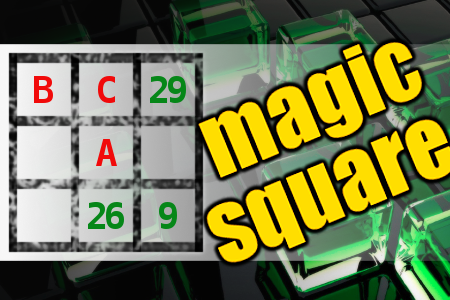
MAGIC SQUARE: Calculate A+B*C
[6931] MAGIC SQUARE: Calculate A+B*C - The aim is to place the some numbers from the list (4, 5, 9, 10, 21, 24, 25, 26, 28, 29, 76) into the empty squares and squares marked with A, B an C. Sum of each row and column should be equal. All the numbers of the magic square must be different. Find values for A, B, and C. Solution is A+B*C. - #brainteasers #math #magicsquare - Correct Answers: 8 - The first user who solved this task is Nasrin 24 T
BRAIN TEASERS
enter your answer and press button OK

MAGIC SQUARE: Calculate A+B*C

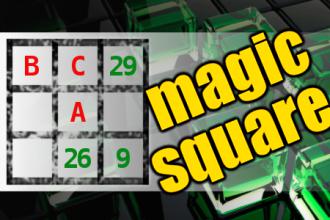
The aim is to place the some numbers from the list (4, 5, 9, 10, 21, 24, 25, 26, 28, 29, 76) into the empty squares and squares marked with A, B an C. Sum of each row and column should be equal. All the numbers of the magic square must be different. Find values for A, B, and C. Solution is A+B*C.
Correct answers: 8
The first user who solved this task is Nasrin 24 T.
#brainteasers #math #magicsquare
Register with your Google Account and start collecting points.
Check your ranking on list.

A golfer, who was known for hi...

A golfer, who was known for his bad temper, walked into the Pro Shop one day and plunked down big bucks for a new set of woods.
The staff all watched to see what would happen after he used them for the first time - more than half expecting he'd come in and demand his money back.
But the next time he came in, he was all smiles.
"They're the best clubs I've ever had," he said. "In fact, I've discovered I can throw them at least 40 yards farther than I could my last ones."
Jokes of the day - Daily updated jokes. New jokes every day.
Follow Brain Teasers on social networks

Brain Teasers

puzzles, riddles, mathematical problems, mastermind, cinemania...

Walter Hess

Born 17 Mar 1881; died 12 Aug 1973 at age 92.Walter Rudolf Hess was a Swiss physiologist whoshared(with António Egas Moniz) the 1949 Nobel Prize for Physiology or Medicine for “for his discovery of the functional organization of the interbrain as a coordinator of the activities of the internal organs.” In 1948, Hess devised suitable techniques to implant electrodes in the brains of rats, from which he could locate areas of the brain associated with certain instincts. Through his research, he identified how particular areas of the brain (and especially the hypothalamus) are involved with the functioning of the body's internal organs, and areas associated with autonomic functions such as sleep, hunger or defense mechanisms.«
This site uses cookies to store information on your computer. Some are essential to help the site properly. Others give us insight into how the site is used and help us to optimize the user experience. See our privacy policy.