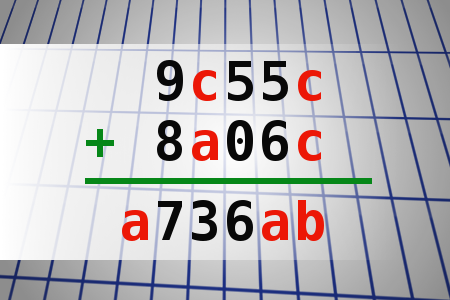
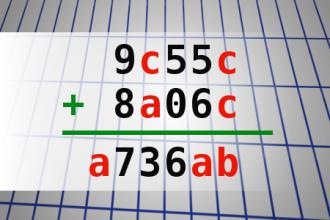
Find number abc
[7024] Find number abc - If 9c55c + 8a06c = a736ab find number abc. Multiple solutions may exist. - #brainteasers #math - Correct Answers: 17 - The first user who solved this task is Nasrin 24 T
BRAIN TEASERS
enter your answer and press button OK

Find number abc

If 9c55c + 8a06c = a736ab find number abc. Multiple solutions may exist.
Correct answers: 17
The first user who solved this task is Nasrin 24 T.
#brainteasers #math
Register with your Google Account and start collecting points.
Check your ranking on list.

Chinese Jews

Sid and Al were sitting in a Chinese restaurant.
"Sid," asked Al, "Are there any Jews in China?"
"I don't know," Sid replied. "Why don't we ask the waiter?"When the waiter came by, Al said, "Are there any Chinese Jews?"
"I don't know sir, let me ask," the waiter replied and he went into the kitchen.
He quickly returned and said, "No, sir. No Chinese Jews."
"Are you sure?" Al asked.
"I will check again, sir." the waiter replied and went back to the kitchen.
While he was still gone, Sid said, "I cannot believe there are no Jews in China. Our people are scattered everywhere."
When the waiter returned he said, "Sir, no Chinese Jews."
"Are you really sure?" Al asked again. "I cannot believe there are no Chinese Jews."
"Sir, I ask everyone," the waiter replied exasperated. "We have orange jews, prune jews, tomato jews and grape jews, but no one ever hear of Chinese jews!"

Jokes of the day - Daily updated jokes. New jokes every day.
Follow Brain Teasers on social networks

Brain Teasers

puzzles, riddles, mathematical problems, mastermind, cinemania...

Sewing Machine

In 1790, Thomas Saint, a London cabinet maker, patented possibly the first sewing machine, fitted with an awl that makes a hole in leather and allows a needle to pass through it. This machine made a chain stitch with a tambour-type needle to produce a mechanical crochet or chain stitch. No evidence exists that Saint produced a single machine, and those who in the 1880's followed his patent specifications failed. An earlier English patent (24 Jun 1755) by German mechanic, Charles Weisenthal, had described a two-pointed needle for mechanical sewing, but there was no mention of a machine to go with it.Image: Wilcox-Gibbs sewing machine, c.1890.
This site uses cookies to store information on your computer. Some are essential to help the site properly. Others give us insight into how the site is used and help us to optimize the user experience. See our privacy policy.