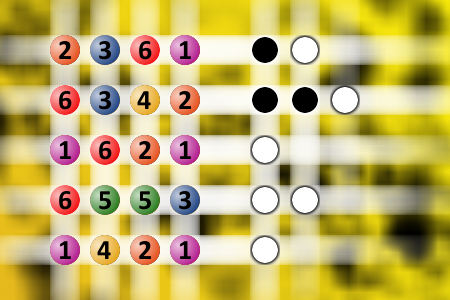

What a winning combination?
[7023] What a winning combination? - The computer chose a secret code (sequence of 4 digits from 1 to 6). Your goal is to find that code. Black circles indicate the number of hits on the right spot. White circles indicate the number of hits on the wrong spot. - #brainteasers #mastermind - Correct Answers: 22 - The first user who solved this task is Nasrin 24 T
BRAIN TEASERS
enter your answer and press button OK

What a winning combination?

The computer chose a secret code (sequence of 4 digits from 1 to 6). Your goal is to find that code. Black circles indicate the number of hits on the right spot. White circles indicate the number of hits on the wrong spot.
Correct answers: 22
The first user who solved this task is Nasrin 24 T.
#brainteasers #mastermind
Register with your Google Account and start collecting points.
Check your ranking on list.

Matt's dad picked him up from...

Matt's dad picked him up from school one afternoon. Knowing the parts for the school play were supposed to be posted today, he asked his son if he got a part. Matt enthusiastically announced that he'd gotten a part. "I play a man who's been married for twenty years."
"That's great, son. Keep up the good work and before you know it they'll be giving you a speaking part."
Jokes of the day - Daily updated jokes. New jokes every day.
Follow Brain Teasers on social networks

Brain Teasers

puzzles, riddles, mathematical problems, mastermind, cinemania...

Gerd Faltings

Born 28 Jul 1954.German mathematician who wasawardedthe 1986 Fields Medal (the highest honour that a young mathematician can receive) primarily for his proof of the Mordell Conjecture which he achieved using methods of arithmetic algebraic geometry. He has also been closely linked with the work leading to the final proof of Fermat's Last Theorem by Andrew Wiles. In 1983 Faltings proved that for every n > 2 there are at most a finite number of coprime integers x, y, z with xn + yn = zn. This was a major step but a proof that the finite number was 0 in all cases did not seem likely to follow by extending Falting's arguments. However, Faltings was the natural person that Wiles turned to when he wanted an opinion on the correctness of his repair of his proof of Fermat's Last Theorem in 1994.
This site uses cookies to store information on your computer. Some are essential to help the site properly. Others give us insight into how the site is used and help us to optimize the user experience. See our privacy policy.