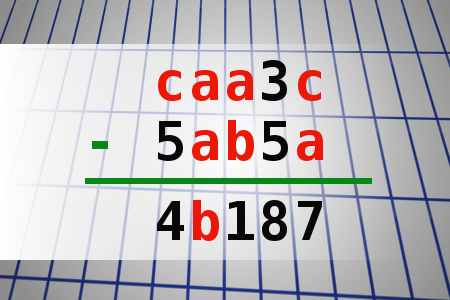
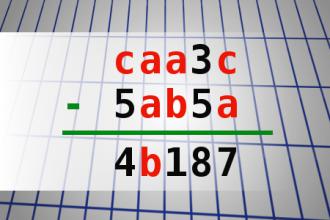
Find number abc
[7083] Find number abc - If caa3c - 5ab5a = 4b187 find number abc. Multiple solutions may exist. - #brainteasers #math - Correct Answers: 16 - The first user who solved this task is Nasrin 24 T
BRAIN TEASERS
enter your answer and press button OK

Find number abc

If caa3c - 5ab5a = 4b187 find number abc. Multiple solutions may exist.
Correct answers: 16
The first user who solved this task is Nasrin 24 T.
#brainteasers #math
Register with your Google Account and start collecting points.
Check your ranking on list.

Murphy's Laws for Parents

1. The tennis shoes you must replace today will go on sale next week.
2. Leakproof thermoses - will.
3. The chances of a piece of bread falling with the grape jelly side down is directly proportional to the cost of the carpet.
4. The garbage truck will be two doors past your house when the argument over whose day it is to take out the trash ends.
5. The shirt you child must wear today will be the only one that needs to be washed or mended.
6. Gym clothes left at school in lockers mildew at a faster rate than other clothing.
7. The item your child lost, and must have for school within the next ten seconds, will be found in the last place you look.
(Tom's note: Isn't something ALWAYS in the last place you look? I mean, you don't keep looking once you've found it, do you?)
8. Sick children recover miraculously when the pediatrician enters the treatment room.
9. Refrigerated items, used daily, will gravitate toward the back of the refrigerator.
10. Your chances of being seen by someone you know dramatically increase if you drive your child to school in your robe and curlers.
Jokes of the day - Daily updated jokes. New jokes every day.
Follow Brain Teasers on social networks

Brain Teasers

puzzles, riddles, mathematical problems, mastermind, cinemania...

Player piano

In 1881, a patent was issued for his invention of a piano player to John McTammany, Jr., of Cambridge, Mass. He had earlier filed a caveat on 7 Sep 1876. His patent descibed his "mechanical mucical instrument" as a mechanism for automatic playing of organs using narrow sheets of perforated flexible paper which governed the notes to be played. The first completely automatic piano player to be manufactured in the U.S. was the Angelus made in Feb 1897, which was patented by its inventor, Edward H. Leveaux, in England on 27 Feb 1879, and who was issued a U.S. patent on 4 Oct 1881 for an "apparatus for storing and transmitting motive power."
This site uses cookies to store information on your computer. Some are essential to help the site properly. Others give us insight into how the site is used and help us to optimize the user experience. See our privacy policy.