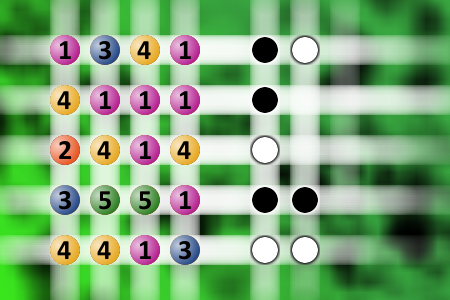
What a winning combination?
[7082] What a winning combination? - The computer chose a secret code (sequence of 4 digits from 1 to 6). Your goal is to find that code. Black circles indicate the number of hits on the right spot. White circles indicate the number of hits on the wrong spot. - #brainteasers #mastermind - Correct Answers: 20 - The first user who solved this task is Nasrin 24 T
BRAIN TEASERS
enter your answer and press button OK

What a winning combination?

The computer chose a secret code (sequence of 4 digits from 1 to 6). Your goal is to find that code. Black circles indicate the number of hits on the right spot. White circles indicate the number of hits on the wrong spot.
Correct answers: 20
The first user who solved this task is Nasrin 24 T.
#brainteasers #mastermind
Register with your Google Account and start collecting points.
Check your ranking on list.

Soap And Water

After several exciting dates, Jim invited Tina over to his house for a home-cooked dinner.
When she sat down at the table, she noticed that the dishes were the dirtiest that she had ever seen in her life.
"Have these dishes ever been washed?" Tina asked, running her fingers over the grit and grime.
Jim replied, "They're as clean as soap and water could get them."
Tina felt a bit apprehensive, but started eating. It was really delicious and she said so, despite the dirty dishes.
When dinner was over, Jim took the dishes outside, whistled and yelled, "Here, Soap! Here, Water!"

Jokes of the day - Daily updated jokes. New jokes every day.
Follow Brain Teasers on social networks

Brain Teasers

puzzles, riddles, mathematical problems, mastermind, cinemania...

Pasteur's germ theory

In 1878, Louis Pasteur lectured at the French Academy of Science in support of his germ theory of disease, in which he held that many diseases were caused by tiny organisms. Since he still met with opposition from some scientists, he called their contrary opinions “fatal to medical progress.”Pasteur also described ways to prevent infection, and provided the skeptics with an experiment with which to prove the theory to themselves.
This site uses cookies to store information on your computer. Some are essential to help the site properly. Others give us insight into how the site is used and help us to optimize the user experience. See our privacy policy.