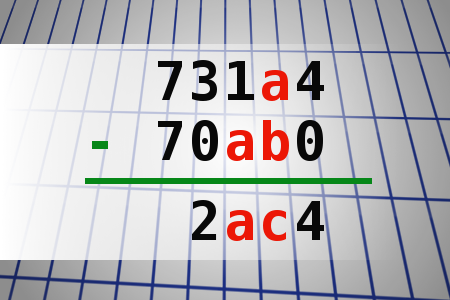
Find number abc
[7101] Find number abc - If 731a4 - 70ab0 = 2ac4 find number abc. Multiple solutions may exist. - #brainteasers #math - Correct Answers: 14
BRAIN TEASERS
enter your answer and press button OK

Find number abc

If 731a4 - 70ab0 = 2ac4 find number abc. Multiple solutions may exist.
Correct answers: 14
#brainteasers #math

Register with your Google Account and start collecting points.
Check your ranking on list.

Number Jokes

A man is sent to prison for the first time. At night, the lights in the cell block are turned off, and his cellmate goes over to the bars and yells, "Number twelve!" The whole cell block breaks out laughing. A few minutes later, somebody else in the cell block yells, "Number four!" Again, the whole cell block breaks out laughing.

The new guy asks his cellmate what's going on. "Well," says the older prisoner, "we've all been in this here prison for so long, we all know the same jokes. So we just yell out the number instead of saying the whole joke."

So the new guy walks up to the bars and yells, "Number twenty-nine!" This time the whole cell block rocks with the loudest laughter, prisoners rolling on the floor laughing hysterically.

When the guffaws die down, the bewildered new guy turns to the older prisoner and asks, "How come you guys were laughing so hard this time?"

"Oh," says the older man wiping tears from his eyes, "we'd never heard that one before."

Jokes of the day - Daily updated jokes. New jokes every day.
Follow Brain Teasers on social networks

Brain Teasers

puzzles, riddles, mathematical problems, mastermind, cinemania...

John Mercer

Died 30 Nov 1866 at age 75 (born 21 Feb 1791).English chemist and industrialist who invented the mercerisation process for treating cotton which is still in use today and was a pioneer in colour photography. From age 16, and throughout his life, he investigated and developed chemical textile dyes. Late in his life, in 1844, he found that when cotton is treated with caustic chemicals, it became thicker and shorter - thereby stronger and shrink-resistant. Further, the cotton was more easily dyed, needed 30% less dye, more absorbant, and could be given an attractive silk-like lustre. He called his process mercerisation and patented it in 1850. Mercerisation was applied to many other materials, such as parchment and woolen fabric, and remains an important part of the cotton finishing process today.
This site uses cookies to store information on your computer. Some are essential to help the site properly. Others give us insight into how the site is used and help us to optimize the user experience. See our privacy policy.