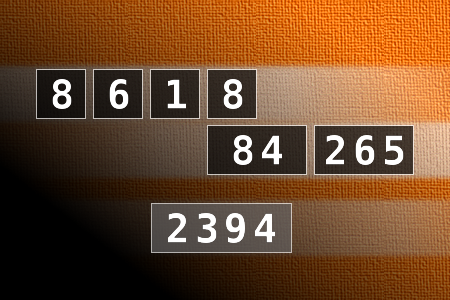
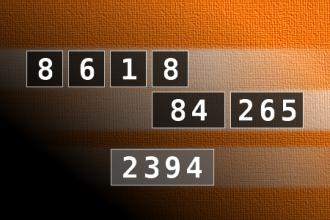
Calculate the number 2394
[7102] Calculate the number 2394 - NUMBERMANIA: Calculate the number 2394 using numbers [8, 6, 1, 8, 84, 265] and basic arithmetic operations (+, -, *, /). Each of the numbers can be used only once. - #brainteasers #math #numbermania - Correct Answers: 3
BRAIN TEASERS
enter your answer and press button OK

Calculate the number 2394

NUMBERMANIA: Calculate the number 2394 using numbers [8, 6, 1, 8, 84, 265] and basic arithmetic operations (+, -, *, /). Each of the numbers can be used only once.
Correct answers: 3
#brainteasers #math #numbermania
Register with your Google Account and start collecting points.
Check your ranking on list.

An old man and his wife went...

An old man and his wife went to the doctor's office and the doctor askedthe man for a blood, urine, and feces sample.The old man was slightly deaf and said, "What?"
Again, the doctor said, "I need a blood, urine and feces sample."
The man still looked puzzled, so his wife leaned over and yelled intohis ear:
"Sheldon, the doctor needs a pair of your underwear!"
Jokes of the day - Daily updated jokes. New jokes every day.
Follow Brain Teasers on social networks

Brain Teasers

puzzles, riddles, mathematical problems, mastermind, cinemania...

Sir Astley Paston Cooper

Born 23 Aug 1768; died 12 Feb 1841 at age 72. (1st Baronet) English surgeon who was a pioneer in experimental surgery. He was the first to tie the abdominal aorta in treating an aneurysm (1817), among various other operations he performed successfully at a time before antiseptic procedures. He was devoted to the study and teaching of anatomy, and is said to have dissected daily throughout his career. In 1820, for removing a small tumour from the head of King George IV, he was rewarded with a baronetcy, and later appointed Sergeant-Surgeon to the King (1828). He wrote many medical books, including his major work The Anatomy and Surgical Treatment of Hernia (1804-07), and Dislocations and Fractures (1822). He became president of the Royal College of Surgeons in 1827, and vice-president of the Royal Society in 1830.«
This site uses cookies to store information on your computer. Some are essential to help the site properly. Others give us insight into how the site is used and help us to optimize the user experience. See our privacy policy.