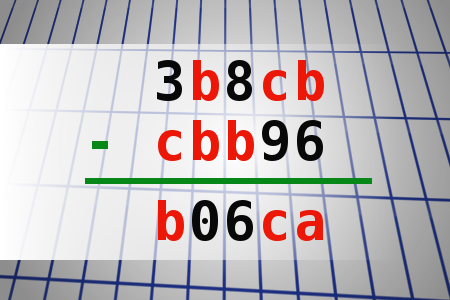
Find number abc
[7139] Find number abc - If 3b8cb - cbb96 = b06ca find number abc. Multiple solutions may exist. - #brainteasers #math - Correct Answers: 5
BRAIN TEASERS
enter your answer and press button OK

Find number abc

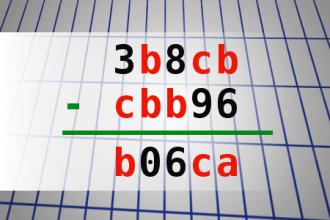
If 3b8cb - cbb96 = b06ca find number abc. Multiple solutions may exist.
Correct answers: 5
#brainteasers #math
Register with your Google Account and start collecting points.
Check your ranking on list.

A boy was assigned a paper on...

A boy was assigned a paper on childbirth and asked his parents, "How was I born?"
"Well honey..." said the slightly prudish parent. "The stork brought you to us."
"Ohh..." said the boy. "Well, how did you and daddy get born?" he asked.
"Oh, your grandparents found us under a rock."
"Well how were grandpa and grandma born?" he persisted.
"Well darling, they were found under a cabbage leaf," said the parent.
Several days later, the boy handed in his paper to the teacher who read with confusion the opening sentence: "This report has been very difficult to write due to the fact that there hasn't been a natural childbirth in my family for three generations."
Jokes of the day - Daily updated jokes. New jokes every day.
Follow Brain Teasers on social networks

Brain Teasers

puzzles, riddles, mathematical problems, mastermind, cinemania...

Sir William Fairbairn

Died 18 Aug 1874 at age 85 (born 19 Feb 1789).(1st Baronet) Scottish civil engineer who was first to use wrought iron for ships, bridges, mill shafts, and structural beams. After moving to London in 1811, he invented a steam excavator and a sausage-making machine, but without commercial success. By 1817, he had established an engineering works in Manchester making mill machinery, which later made over 400 locomotives. The shipbuilding works he opened at Millwall, London (1835-49) built hundreds of iron boats. He furnished the rectangular wrought-iron tubes used by Stephenson for the Britannia railway bridge (1850) over the Menai Strait, which included two almost 460-ft (140-m) spans. He assisted James Joule and Lord Kelvin in geological investigations from 1851.«
This site uses cookies to store information on your computer. Some are essential to help the site properly. Others give us insight into how the site is used and help us to optimize the user experience. See our privacy policy.