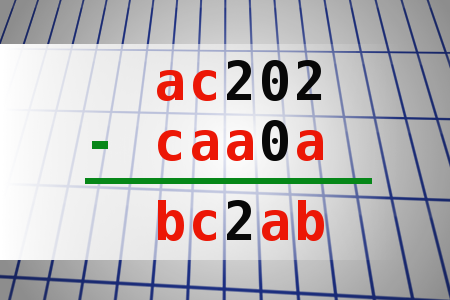
Find number abc
[7188] Find number abc - If ac202 - caa0a = bc2ab find number abc. Multiple solutions may exist. - #brainteasers #math - Correct Answers: 8
BRAIN TEASERS
enter your answer and press button OK

Find number abc

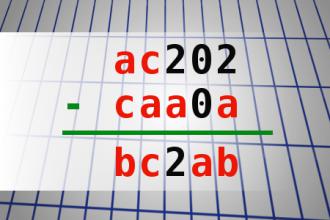
If ac202 - caa0a = bc2ab find number abc. Multiple solutions may exist.
Correct answers: 8
#brainteasers #math
Register with your Google Account and start collecting points.
Check your ranking on list.

The loan

Before going to Europe on business, a man drove his Rolls-Royce to a downtown New York City bank and went in to ask for an immediate loan of $5,000.

The bank officer says the bank will need some kind of security for such a loan. So the businessman hands over the keys to a Rolls-Royce parked on the street in front of the bank. Everything checks out, and the bank agrees to accept the car as collateral for the loan. An employee drives the Rolls into the bank's underground garage and parks it there.

Two weeks later, the businessman returns, repays the $5,000 and the interest, which comes to $15.40. The loan officer says, "We are very happy to have had your business, and this transaction has worked out very nicely, but we are a little puzzled. While you were away, we checked you out and found that you are a multimillionaire. What puzzles us is: why would you bother to borrow $5,000?"

The man smiled. "Where else could I park my Rolls-Royce in Manhattan for two weeks and pay only $15.40?"

Jokes of the day - Daily updated jokes. New jokes every day.
Follow Brain Teasers on social networks

Brain Teasers

puzzles, riddles, mathematical problems, mastermind, cinemania...

Sir Edward Burnett Tylor

Died 2 Jan 1917 at age 84 (born 2 Oct 1832).English anthropologist regarded as the founder of cultural anthropology. After travelling in the U.S. (1855-56) he proceeded to Cuba (1856), where he met Henry Christy the ethnologist. Together they visited Mexico, where Christy's influence greatly stimulated Tylor's interest in anthropology. Seeing the rich prehistoric remains in Mexico led Tylor to make a systematic study of the science. In his most important work, Primitive Culture (1871), being influenced by Darwin's theory of biological evolution, he developed the theory of an evolutionary, progressive relationship between primitive and modern cultures. By 1883, he was Keeper of the University Museum at Oxford and Professor of Anthropology there 1896-1909. He was knighted in 1912.
This site uses cookies to store information on your computer. Some are essential to help the site properly. Others give us insight into how the site is used and help us to optimize the user experience. See our privacy policy.