Find number abc
[7199] Find number abc - If bb122 - b24cb = cbab find number abc. Multiple solutions may exist. - #brainteasers #math - Correct Answers: 6
BRAIN TEASERS
enter your answer and press button OK

Find number abc

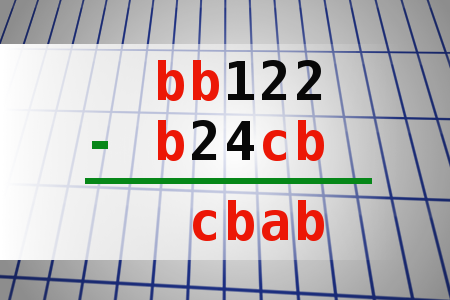
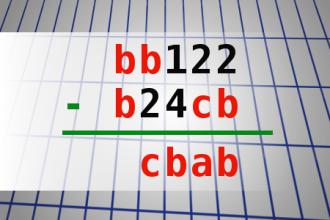
If bb122 - b24cb = cbab find number abc. Multiple solutions may exist.
Correct answers: 6
#brainteasers #math
Register with your Google Account and start collecting points.
Check your ranking on list.

The Dentist

The dentist pulls out a Novocain needle to give the man a shot, so he can extract the man's tooth. 'No way! No needles. I hate needles' the patient said.
The dentist starts to hook up the nitrous oxide and the man objects I can't do the gas thing. The thought of having the gas mask on is suffocating to me! The dentist then asks the patient if he has any objection to taking a pill. 'No objection,' the patient says. 'I'm fine with pills.'
The dentist then returns and says, Here's a Viagra tablet.'
The patient says, 'Wow! I didn't know Viagra worked as a pain killer!'
It doesn't' said the dentist, 'but it's going to give you something to hold on to when I pull your tooth.      

Jokes of the day - Daily updated jokes. New jokes every day.
Follow Brain Teasers on social networks

Brain Teasers

puzzles, riddles, mathematical problems, mastermind, cinemania...

Auguste Bravais

Born 23 Aug 1811; died 30 Mar 1863 at age 51.French physicist and mineralogist, best remembered for his work on the lattice theory of crystals. Bravais lattices are named for him. In 1850, he showed that crystals could be divided into 14 unit cells for which: (a) the unit cell is the simplest repeating unit in the crystal; (b) opposite faces of a unit cell are parallel; and (c) the edge of the unit cell connects equivalent points. These unit cells fall into seven geometrical categories, which differ in their relative edge lengths and internal angles. In 1866, he elaborated the relationships between the ideal lattice and the material crystal. Sixty years later, Bravais' work provided the mathematical and conceptual basis for the determination of crystal structures after Laue's discovery of X-ray diffraction in 1911.
This site uses cookies to store information on your computer. Some are essential to help the site properly. Others give us insight into how the site is used and help us to optimize the user experience. See our privacy policy.