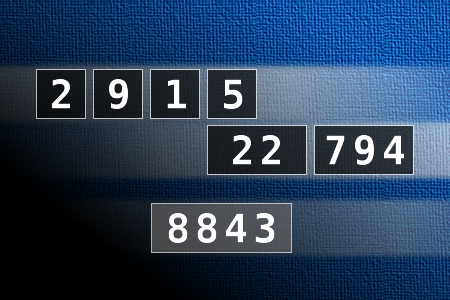
Calculate the number 8843
[7200] Calculate the number 8843 - NUMBERMANIA: Calculate the number 8843 using numbers [2, 9, 1, 5, 22, 794] and basic arithmetic operations (+, -, *, /). Each of the numbers can be used only once. - #brainteasers #math #numbermania - Correct Answers: 3
BRAIN TEASERS
enter your answer and press button OK

Calculate the number 8843

NUMBERMANIA: Calculate the number 8843 using numbers [2, 9, 1, 5, 22, 794] and basic arithmetic operations (+, -, *, /). Each of the numbers can be used only once.
Correct answers: 3
#brainteasers #math #numbermania
Register with your Google Account and start collecting points.
Check your ranking on list.

Disappearing diner

A man and a beautiful woman were having dinner in a fine restaurant. Their waitress, taking another order at a table a few paces away suddenly noticed that the man was slowing sliding down his chair and under the table, but the woman acted unconcerned. The waitress watched as the man slid all the way down his chair and out of sight under the table. Still, the woman dining across from him appeared calm and unruffled, apparently unaware that her dining companion had disappeared.

After the waitress finished taking the order, she came over to the table and said to the woman, "Pardon me, ma'am, but I think your husband just slid under the table." The woman calmly looked up at her and replied firmly, "No he didn't. My husband just walked in the door."

Jokes of the day - Daily updated jokes. New jokes every day.
Follow Brain Teasers on social networks

Brain Teasers

puzzles, riddles, mathematical problems, mastermind, cinemania...

Robert Innes

Died 13 Mar 1933 at age 71 (born 10 Nov 1861).Robert Thorburn Ayton Innes was a Scottish astronomer who discovered Proxima Centauri (1915), the closest star to earth after the Sun. Invited by David Gill to the Cape Observatory, South Africa (1894), he became a successful binary star observer with the 7-inch refractor (1628 discoveries). His most famous discovery, Proxima Centauri is a faint star near the binary star Alpha Centauri, which is so far south it is not visible from most of the northern hemisphere. He was also the first to see the Daylight Comet of 1910, though this comet was found independently by so many people in the Southern Hemisphere that no single "original'' discoverer could be named. Innes recorded it on 17 Jan 1910.
This site uses cookies to store information on your computer. Some are essential to help the site properly. Others give us insight into how the site is used and help us to optimize the user experience. See our privacy policy.