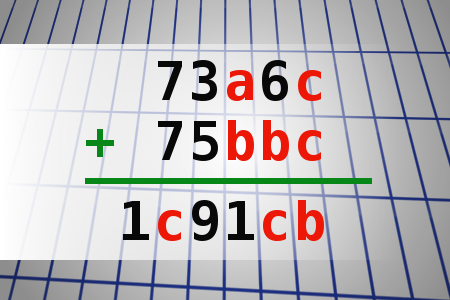
Find number abc
[7223] Find number abc - If 73a6c + 75bbc = 1c91cb find number abc. Multiple solutions may exist. - #brainteasers #math - Correct Answers: 5
BRAIN TEASERS
enter your answer and press button OK

Find number abc

If 73a6c + 75bbc = 1c91cb find number abc. Multiple solutions may exist.
Correct answers: 5
#brainteasers #math
Register with your Google Account and start collecting points.
Check your ranking on list.

Dog playing piano

It is World Piano Day!

A man walks into a bar with a small dog under his arm and sits down at the counter, placing the dog on the stool next to him. The bartender says, "Sorry, pal. No dogs allowed."
The man says, "But this is a special dog – he plays the piano!"
The bartender replies, "Well, if he can play that piano, you both can stay... and have a drink on the house!"
So the man puts the dog on the piano stool, and the dog starts playing. Ragtime, Mozart... and then he plays some rock 'n' roll. The bartender and patrons are amazed.
Suddenly, a bigger dog runs in, grabs the small dog by the scruff of the neck, and drags him out. The bartender asks the man, "What was that all about?"
The man replies, "Oh, that was his mother. She wanted him to be a doctor."

Jokes of the day - Daily updated jokes. New jokes every day.
Follow Brain Teasers on social networks

Brain Teasers

puzzles, riddles, mathematical problems, mastermind, cinemania...

Alexander William Williamson

Born 1 May 1824; died 6 May 1904 at age 80. English chemist whose research on alcohols and ethers clarified organic molecular structure. He was the first to explain the action of a catalyst in terms of the formation of an intermediate compound. Williamson was the first to make 'mixed' ethers, with two different alkyl groups, by a method still known as the Williamson synthesis in which an alkoxide reacts with with an alkyl halide. In the early 1850's, he first noted and described reversible reactions such as those of alcohols and ethers in which products of a reaction may recombine to form the reactants). He named the "dynamic equilibrium" in the case where the rate of the forward reaction is the same as that of the reverse reaction, and all compounds in the process coexist.
This site uses cookies to store information on your computer. Some are essential to help the site properly. Others give us insight into how the site is used and help us to optimize the user experience. See our privacy policy.