MAGIC SQUARE: Calculate A-B-C
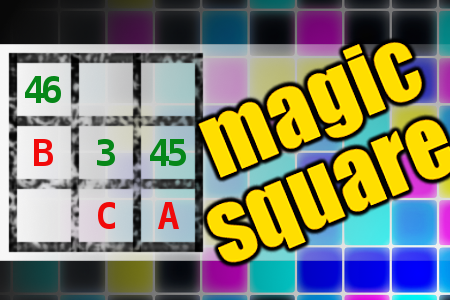
[7224] MAGIC SQUARE: Calculate A-B-C - The aim is to place the some numbers from the list (2, 3, 9, 25, 26, 32, 45, 46, 52, 80, 82) into the empty squares and squares marked with A, B an C. Sum of each row and column should be equal. All the numbers of the magic square must be different. Find values for A, B, and C. Solution is A-B-C. - #brainteasers #math #magicsquare - Correct Answers: 3
BRAIN TEASERS
enter your answer and press button OK

MAGIC SQUARE: Calculate A-B-C

The aim is to place the some numbers from the list (2, 3, 9, 25, 26, 32, 45, 46, 52, 80, 82) into the empty squares and squares marked with A, B an C. Sum of each row and column should be equal. All the numbers of the magic square must be different. Find values for A, B, and C. Solution is A-B-C.
Correct answers: 3
#brainteasers #math #magicsquare
Register with your Google Account and start collecting points.
Check your ranking on list.

Vatican Fried Chicken

During a Papal audience, a business man approached the Pope and made this offer: Change the last line of the Lord's prayer from "Give us this day our daily bread" to "Give us this day our daily chicken," and Kentucky Fried Chicken will donate $10,000,000 to Catholic charities. The Pope declined.Two weeks later, the man approached the Pope again - this time with a $50,000,000 offer. Again, the Pope declined. A month later, the man upped the price to $100,000,000, and this time the Pope accepted.At a meeting of the Cardinals, the Pope announced his decision in the good news/bad news format. "The good news is: We have $100,000,000 for charities. The bad news: We lost the Wonder Bread account."
Jokes of the day - Daily updated jokes. New jokes every day.
Follow Brain Teasers on social networks

Brain Teasers

puzzles, riddles, mathematical problems, mastermind, cinemania...

John Z. Young

Born 18 Mar 1907; died 4 Jul 1997 at age 90. John Zachary Young was an English zoologist and neuroscientist who had a passionate interest in how animals function, and their brains in particular. His research laid a foundation for modern neurobiology. His career began as a cephalopod biologist, curious also in physiology, experimental psychology and philosophy, but became a neuroscientist. His first paper (1929) was on the previously undescribed epistellar body in the octopus. He continued his research on cephalopods (octopus, squids, cuttlefish and nautiloids) with experiments on octopus learning and the basis of memory. He wrote many more papers on this subject. He identified distinct stores in the octopus brain for visual and touch memories, a brain far more complicated than previously known.«
This site uses cookies to store information on your computer. Some are essential to help the site properly. Others give us insight into how the site is used and help us to optimize the user experience. See our privacy policy.