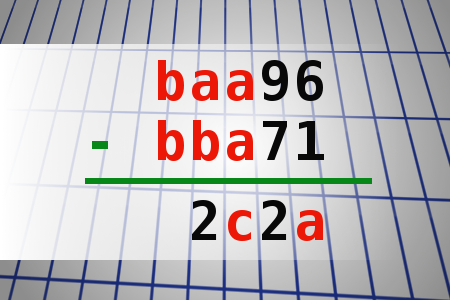
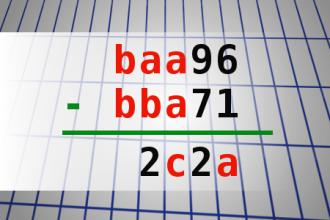
Find number abc
[7293] Find number abc - If baa96 - bba71 = 2c2a find number abc. Multiple solutions may exist. - #brainteasers #math - Correct Answers: 4
BRAIN TEASERS
enter your answer and press button OK

Find number abc

If baa96 - bba71 = 2c2a find number abc. Multiple solutions may exist.
Correct answers: 4
#brainteasers #math
Register with your Google Account and start collecting points.
Check your ranking on list.

Mail

A man was in his front yard mowing grass when his neighbor came out of the house and went straight to the mail box, opened it, then slammed it shut, and stormed back in the house.

A little later they came out again went to the mail box and again opened it, then slammed it shut again.

Angrily, back into the house they went.

As the man was getting ready to edge the lawn, the neighbor came out again, marched to the mail box, opened it and then slammed it closed harder than ever. Puzzled by his neighbors actions the man asked, "Is something wrong?"

To which the neighbor (who was not very computer savvy) replied, "There certainly is! My stupid computer keeps giving me a message saying, "YOU'VE GOT MAIL!"

Jokes of the day - Daily updated jokes. New jokes every day.
Follow Brain Teasers on social networks

Brain Teasers

puzzles, riddles, mathematical problems, mastermind, cinemania...

William Thomas Astbury

Born 25 Feb 1898; died 4 Jun 1961 at age 63. English physical biochemist who was the first to make use of X-ray diffraction patterns to study the structure of nucleic acids (1937). Astbury researched the method under Bragg for seven years, then investigated the structure of wool in both the stretched and unstretched forms. From the difference in the diffraction patterns, he began to try to work ot the structure of protein molecules. His preliminary determination of the structure of nucleic acids were, in fact, wrong - but it gave impetus to Pauling's work with proteins, and to Crick and Watson's study of DNA structure. His work, slowly decoding the nature of molecular structure of virtually the largest organic materials, fibrous and globular proteins, was valuable to both science and industry.
This site uses cookies to store information on your computer. Some are essential to help the site properly. Others give us insight into how the site is used and help us to optimize the user experience. See our privacy policy.