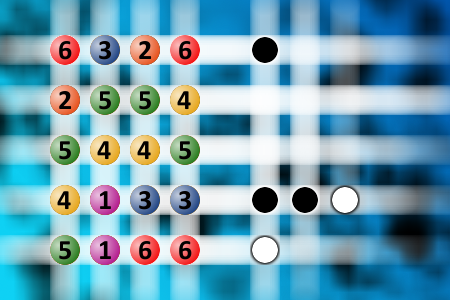
Which is a winning combination of digits?
[7306] Which is a winning combination of digits? - The computer chose a secret code (sequence of 4 digits from 1 to 6). Your goal is to find that code. Black circles indicate the number of hits on the right spot. White circles indicate the number of hits on the wrong spot. - #brainteasers #mastermind - Correct Answers: 10
BRAIN TEASERS
enter your answer and press button OK

Which is a winning combination of digits?

The computer chose a secret code (sequence of 4 digits from 1 to 6). Your goal is to find that code. Black circles indicate the number of hits on the right spot. White circles indicate the number of hits on the wrong spot.
Correct answers: 10
#brainteasers #mastermind
Register with your Google Account and start collecting points.
Check your ranking on list.

Before going to Europe on busi...

Before going to Europe on business, a man drives his Rolls-Royce to a downtown New York City bank and asks for an immediate loan of $5,000. The loan officer, taken aback, requests collateral. "Well then, here are the keys to my Rolls-Royce," the man says. The loan officer promptly has the car driven into the bank's underground parking for safe keeping and gives the man the $5,000. Two weeks later, the man walks through the bank's doors and asks to settle up his loan and get his car back. "That will be $5,000 in principal, and $15.40 in interest," the loan officer says. The man writes out a check and starts to walk away. "Wait, sir," the loan officer says. "You are a millionaire. Why in the world would you need to borrow $5,000?" The man smiles, "Where else could I find a safer place to park my Rolls-Royce in Manhattan for two weeks and pay only $15.40?"
Jokes of the day - Daily updated jokes. New jokes every day.
Follow Brain Teasers on social networks

Brain Teasers

puzzles, riddles, mathematical problems, mastermind, cinemania...

Werner Heisenberg

Born 5 Dec 1901; died 1 Feb 1976 at age 74. Werner Karl Heisenberg was the German physicist and philosopher who discovered a way to formulate quantum mechanics in terms of matrices (1925). For that discovery, he was awarded the Nobel Prize for Physics for 1932. In 1927 he published his indeterminacy, or uncertainty, principle, upon which he built his philosophy and for which he is best known. He also made important contributions to the theories of the hydrodynamics of turbulence, the atomic nucleus, ferromagnetism, cosmic rays, and elementary particles, and he planned the first post-World War II German nuclear reactor, at Karlsruhe, then in West Germany.
This site uses cookies to store information on your computer. Some are essential to help the site properly. Others give us insight into how the site is used and help us to optimize the user experience. See our privacy policy.