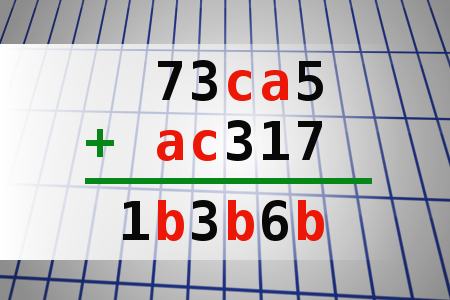
Find number abc
[7381] Find number abc - If 73ca5 + ac317 = 1b3b6b find number abc. Multiple solutions may exist. - #brainteasers #math - Correct Answers: 5
BRAIN TEASERS
enter your answer and press button OK

Find number abc

If 73ca5 + ac317 = 1b3b6b find number abc. Multiple solutions may exist.
Correct answers: 5
#brainteasers #math
Register with your Google Account and start collecting points.
Check your ranking on list.

A young boy enters a barbersho...

A young boy enters a barbershop and the barber whispers to his customer, "This is the dumbest kid in the world. Watch while I prove it to you."
The barber puts a dollar bill in one hand and two quarters in the other, then calls the boy over and asks, "Which do you want, son?"
The boy takes the quarters and leaves.
"What did I tell you?" said the barber. "That kid never learns!"
Later, when the customer leaves, he sees the same young boy coming out of the ice cream store. "Hey, son! May I ask you a question? Why did you take the quarters instead of the dollar bill?"
The boy licked his cone and replied, "Because the day I take the dollar, the game's over!"
Jokes of the day - Daily updated jokes. New jokes every day.
Follow Brain Teasers on social networks

Brain Teasers

puzzles, riddles, mathematical problems, mastermind, cinemania...

Philip Hauge Abelson

Died 1 Aug 2004 at age 91 (born 27 Apr 1913). American physical chemist who proposed the gas diffusion process for separating uranium-235 from uranium-238 which was essential to the development of the atomic bomb. In collaboration with the U.S. physicist Edwin M. McMillan, he discovered a new element, later named neptunium, produced by irradiating uranium with neutrons. At the end WW II, his report on the feasibility of building a nuclear-powered submarine gave birth to the U.S. program in that field. In 1946, Abelson returned to the Carnegie Institution and pioneered in utilizing radioactive isotopes. As director of the Geophysics Laboratory of the Carnegie Institution (1953-71), he found amino acids in fossils, and fatty acids in rocks more than 1,000,000,000 years old.
This site uses cookies to store information on your computer. Some are essential to help the site properly. Others give us insight into how the site is used and help us to optimize the user experience. See our privacy policy.