Find the right combination
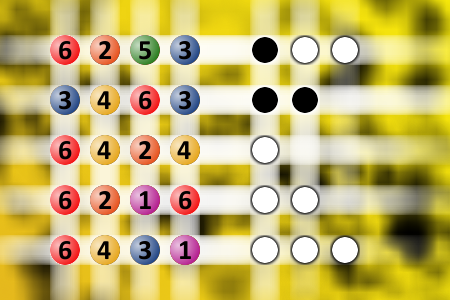
[7380] Find the right combination - The computer chose a secret code (sequence of 4 digits from 1 to 6). Your goal is to find that code. Black circles indicate the number of hits on the right spot. White circles indicate the number of hits on the wrong spot. - #brainteasers #mastermind - Correct Answers: 9
BRAIN TEASERS
enter your answer and press button OK

Find the right combination

The computer chose a secret code (sequence of 4 digits from 1 to 6). Your goal is to find that code. Black circles indicate the number of hits on the right spot. White circles indicate the number of hits on the wrong spot.
Correct answers: 9
#brainteasers #mastermind
Register with your Google Account and start collecting points.
Check your ranking on list.

Julian McCullough: List of Priorities

I dont have any curtains in my apartment. I tried to buy curtains; I went to the store, I was like, I would like these curtains, please. And they were like, $40. And I was like, Nope. Found out right then just how low on my list of priorities curtains were. It turns out Id rather get drunk once than ever have curtains for the rest of my life.
Jokes of the day - Daily updated jokes. New jokes every day.
Follow Brain Teasers on social networks

Brain Teasers

puzzles, riddles, mathematical problems, mastermind, cinemania...

William Prout

Born 15 Jan 1785; died 9 Apr 1850 at age 65. English biochemist and physiologist who is noted for his discoveries concerning digestion, metabolic chemistry, and atomic weights. He is best known for formulating Prout's hypothesis (1815) which states that the atomic weights of all elements are exact multiples of the atomic weight of hydrogen. At that time the atomic weight of hydrogen was taken to be 1.0, the hypothesis implied that all atomic weights would be whole numbers. In 1818, he isolated urea and uric acid for the first time. Six years later, he found hydrochloric acid in the digestive juices of the stomach. He was the first scientist (1827) to classify the components of food into the three main divisions of carbohydrates, fats and proteins. In 1920, Ernest Rutherford named the proton after Prout.
This site uses cookies to store information on your computer. Some are essential to help the site properly. Others give us insight into how the site is used and help us to optimize the user experience. See our privacy policy.