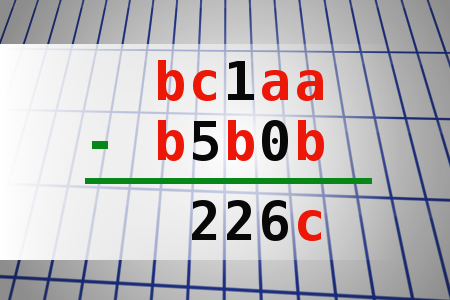
Find number abc
[7401] Find number abc - If bc1aa - b5b0b = 226c find number abc. Multiple solutions may exist. - #brainteasers #math - Correct Answers: 3
BRAIN TEASERS
enter your answer and press button OK

Find number abc

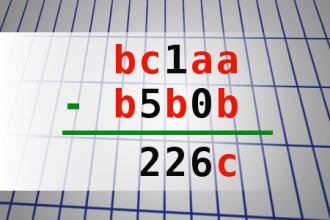
If bc1aa - b5b0b = 226c find number abc. Multiple solutions may exist.
Correct answers: 3
#brainteasers #math
Register with your Google Account and start collecting points.
Check your ranking on list.

Kissing Blarney Stone

A group of Americans were touring Ireland.

One woman in the group was constantly grumbling: The bus seats are uncomfortable. The food is terrible. It's too hot. It's too cold. The accommodations are awful.

The group reached the site of the famous Blarney Stone. "Kissing the Blarney Stone brings good luck all your life," the guide explained. "Unfortunately, it's being cleaned today, so no one can kiss it. Maybe we can return tomorrow."

"We can't be here tomorrow," the cantankerous woman snapped. "We have another dull tour to attend. So, I guess we can't kiss that silly stone."

"Well," the guide replied, "it's said that if you kiss someone who has kissed the stone, you'll receive the same good fortune."

"I suppose you've kissed the stone," the woman scoffed.

"No, ma'am," the exasperated guide responded, "but I've sat on it."

Jokes of the day - Daily updated jokes. New jokes every day.
Follow Brain Teasers on social networks

Brain Teasers

puzzles, riddles, mathematical problems, mastermind, cinemania...

Royal Greenwich Observatory

In 1675, the Royal Greenwich Observatory was created by Royal Warrant in England by Charles II. Building designed by Sir Christopher Wren (who was also a Professor of Astronomy) was commenced 10 Aug 1675 and finished the following year by John Flamsteed was appointed as the first Astronomer Royal. Its primary uses were in practical astronomy - navigation, timekeeping, determination of star positions. In 1767 the observatory began publishing The Nautical Almanac, which established the longitude of Greenwich as a baseline for time calculations. The almanac's popularity among navigators led in part to the adoption (1884) of the Greenwich meridian as the Earth's prime meridian (0° longitude) and the international time zones.
This site uses cookies to store information on your computer. Some are essential to help the site properly. Others give us insight into how the site is used and help us to optimize the user experience. See our privacy policy.